Quick Answer
The Kingston Farmers Market at Springer Market Square runs Tuesday, Thursday, and Saturday. Here's what's worth going for, the vendors that locals return to every week, and how to get there without a car.
The Kingston Public Market has been running continuously since 1801, making it one of the oldest farmers' markets in Ontario. On a Saturday morning in September, Springer Market Square fills with vendors selling produce from farms in Prince Edward County and Lennox & Addington, along with prepared foods, artisan goods, and whatever happened to be harvested that week. For students who've spent their first few weeks eating from meal plans or grocery chains, the first visit to the Kingston market is often a genuine surprise.
The Basics: When and Where
Location: Springer Market Square, 216 Ontario Street (behind City Hall, at the waterfront)
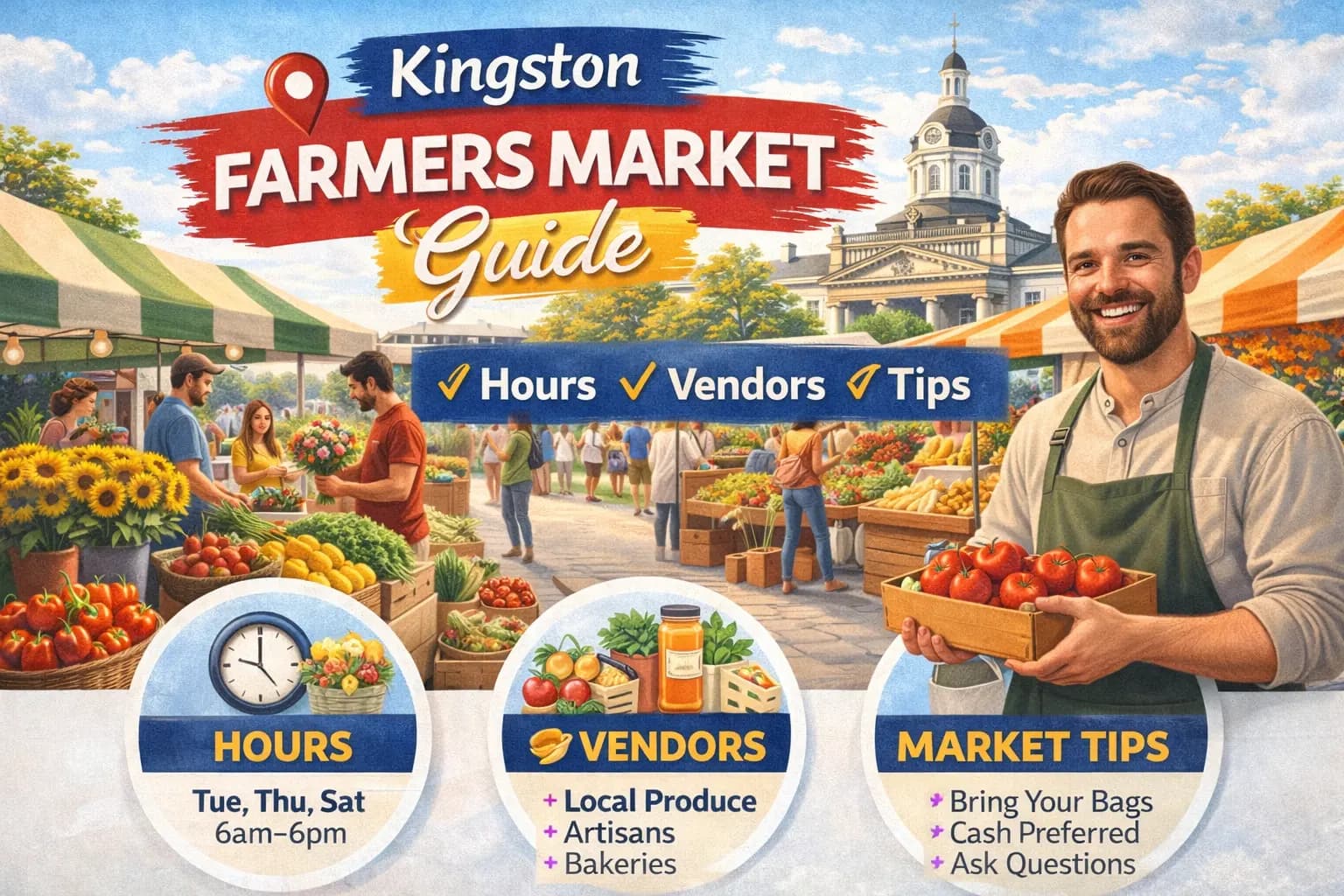
Summer/Fall (May–November): Tuesdays and Thursdays, 7am–6pm; Saturdays 7am–6pm. The Saturday market is significantly larger.
Winter Market (December–April): Saturdays only, moved indoors to the Artillery Park Aquatic Centre on Wellington Street.
The Saturday market is the one to go to. It's roughly three times the size of the weekday markets, with more vendors, more variety, and more of the prepared food options that make it worth visiting even if you're not doing serious grocery shopping.
What to Actually Buy
The Kingston market excels in a few specific categories:
Produce
The quality gap between farmers' market produce and grocery chain produce is most obvious with tomatoes in late August and September, corn in July and August, and apples in October. These items are often harvested within 24-48 hours of market day from farms 20-40 minutes from Kingston. A grocery store tomato in August has typically been picked green and ripened in transport. The difference is noticeable.
What to look for by season:
- June: Strawberries, asparagus, early lettuces
- July-August: Sweet corn, tomatoes, zucchini, peaches, blueberries
- September-October: Apples (multiple varieties), squash, carrots, potatoes, late tomatoes
- Year-round: Eggs, honey, maple syrup, root vegetables in storage
Prepared Foods
The prepared food vendors are underrated. Regular options include fresh bread from local bakeries, pierogi (often sold hot), Korean food, Middle Eastern options, and rotating vendors. The lineups on Saturday mornings give you a quick read on what's worth waiting for.
Eggs
Farm eggs from the Kingston market consistently have darker yolks and better flavor than supermarket eggs. At $5-7 per dozen, they're comparable in price to premium grocery store eggs. Worth buying if you cook regularly.
How to Navigate It Without Overspending
The market can nudge spending higher than grocery shopping if you're not intentional. A few practices that keep it in budget:
- Walk the entire market before buying anything. Prices vary between vendors for the same item, and you'll see what looks best before committing.
- Go later in the morning (10-11am) for potential discounts. Some vendors reduce prices on produce they don't want to pack up.
- Buy in quantity when something is clearly peak-season and priced well. A flat of strawberries in June can be frozen for smoothies through fall.
- Bring your own bags. Some vendors don't have them.
For Students: Is the Market Worth the Premium?
Honest answer: for most categories, not really — but for a few specific things, yes. A regular grocery shop is cheaper and more convenient. But the farmers' market is worth visiting for:
- Peak-season tomatoes, corn, and apples — the quality difference is real and these are priced competitively
- Eggs and honey, where local sourcing has a noticeable quality difference
- Maple syrup — prices at the market are often better than grocery stores for real maple syrup (not pancake syrup)
- The Saturday morning experience itself — it's a functioning part of Kingston's downtown, and understanding what's in season is genuinely useful for cooking
Getting There
The market is at the waterfront, a 15-20 minute walk from the Queen's campus core (University/Earl area). It's on bus routes from most Kingston neighborhoods. Parking exists in the immediate area but is competitive on Saturday mornings — walking or biking is easier.
Is the Kingston Farmers Market open year-round?
Yes. The outdoor market at Springer Market Square runs May through November (Tuesdays, Thursdays, and Saturdays). The winter market runs December through April on Saturdays only, indoors at Artillery Park Aquatic Centre on Wellington Street.
Can you use debit or credit card at the Kingston market?
Many vendors now accept card payments, but not all. Bring some cash as a backup, especially for smaller vendors and prepared food stalls. The Saturday market has an ATM within a few minutes' walk.
What time does the Kingston market get crowded?
Peak crowd is 9-11am on Saturdays. If you want the best selection, arrive by 8:30am. If you want fewer crowds and potential end-of-day deals, arrive after 11am.
Kingston Public Market: What It Is and Where to Find It
The Kingston Public Market at Market Square (Confederation Place, adjacent to City Hall) has operated since the 1800s. It runs year-round — the outdoor market operates spring through late fall, with an indoor winter market on Saturdays through the colder months. From Queen's campus: 20 minutes on foot, 10 minutes by bus on Route 1, or 10 minutes by bike along the waterfront path.
Market Schedule and Hours 2026
| Season | Days | Hours | Location |
|---|---|---|---|
| Spring–Fall (May–Nov) | Tue, Thu, Sat | 8am–2pm (Sat until 3pm) | Market Square, Confederation Place |
| Winter (Nov–April) | Saturday | 9am–1pm | Indoor (check kingstonpublicmarket.ca) |
What to Buy at the Market vs. the Supermarket
Worth buying at market: local farm eggs (comparable price, meaningfully fresher), in-season vegetables (August tomatoes, September corn, October squash — cheaper and better than out-of-season supermarket equivalents), honey from local Kingston-area producers ($10–$15 for a 500g jar), and artisan bread. Skip at market: staples like rice, pasta, canned goods, and dairy. The student strategy: do your main grocery run at No Frills or Real Canadian Superstore, then supplement with a $15–$20 Saturday market visit for seasonal produce and eggs.
Prepared Food and Social Dimension
Several Saturday market vendors sell ready-to-eat food — hot prepared foods, soups, and ethnic food at $6–$12 for a filling meal. A $15 Saturday morning that gets you fresh produce, eggs, and a market breakfast while walking along Kingston's waterfront is genuinely one of the better ways to spend a weekend morning. Going with a housemate makes it a social outing rather than an errand. The market is one of the better arguments for a Kingston student having a bike — the 10-minute waterfront ride beats the 20-minute walk.
When is the Kingston Public Market open in 2026?
The Kingston Public Market at Market Square operates Tuesday, Thursday, and Saturday from approximately May through November, with Saturday hours 8am–3pm and Tuesday/Thursday 8am–2pm. A smaller winter indoor market continues on Saturdays from November through April, 9am–1pm. Check kingstonpublicmarket.ca for the current 2026 schedule and any date changes around statutory holidays.
Is the Kingston Farmers Market worth going to as a student?
Yes — for specific categories. Worth visiting for fresh seasonal vegetables (significantly better than supermarket equivalents in summer and fall), local eggs, honey, and artisan bread. Not worth replacing your regular grocery run — supermarkets beat market pricing on staples. The practical approach: a $15–$20 Saturday market stop for seasonal produce and eggs, combined with a weekly supermarket run for everything else. The Confederation Place waterfront location and food vendor options make it worth going at least once as a Kingston orientation experience, and regularly as a habit if you value fresh local produce.
What Changes at the Kingston Market Through the Seasons
One of the most useful things to understand about the Kingston Public Market is how dramatically the product offering changes through the seasons. A student who visits once in July and assumes they understand what the market offers is missing the point — the October market has almost nothing in common with the June market in terms of what's available.
June: strawberries, early peas, asparagus, spring lettuce, fresh herbs. The market is starting to fill with summer produce but the full abundance isn't there yet. Good for herbs and greens. July and August: the peak of Kingston's growing season. Tomatoes, peppers, zucchini, corn, beans, cucumbers. Multiple vendors competing on the same produce means the pricing is competitive and the quality is genuinely excellent. This is the highest-value window for buying market produce over supermarket produce. September: the transition to fall crops. Butternut squash, apple varieties from local orchards, root vegetables, the last of the summer tomatoes. October: squash, apples, pears, root vegetables. Some vendors begin wrapping up for the season. November: the outdoor market season ends; the winter indoor market begins with a reduced vendor count but still-solid offerings of storage produce, preserved goods, and artisan products.
For students who arrive in Kingston in September and want to experience the market at its best, the last two weeks of September and the first two weeks of October represent a genuine sweet spot — the fall produce is at peak, the summer heat has broken, and the Saturday market is still outdoors at Confederation Place with the waterfront backdrop. Making it to the Kingston Public Market at least once in this window is a worthwhile Kingston experience regardless of whether you buy anything. The local agriculture of Frontenac and Lennox and Addington Counties is one of the less-appreciated aspects of Kingston's regional food culture, and the market is the most accessible window into it for a Queen's student.
Budgeting Smart at the Kingston Public Market
The Kingston Public Market can be significantly cheaper or significantly more expensive than a supermarket depending on what you're buying and when. The categories where market prices beat grocery store prices: seasonal vegetables at peak season (especially July and August), locally grown herbs, fresh eggs from local farms, and specialty preserves and jams that have no supermarket equivalent. The categories where market prices are higher: packaged goods, anything with significant processing or branding, and off-season produce trucked in from outside the region.
The strategy that maximizes value: buy vegetables and protein at the market, buy shelf-stable staples at No Frills or Real Canadian Superstore. A student who shops this way spends $15–$25 at the Saturday Kingston market for enough fresh vegetables and eggs for the week, then completes their grocery run at No Frills for rice, pasta, canned goods, and other staples. The combined cost is comparable to or lower than shopping entirely at a supermarket while delivering genuinely better produce quality.
Arriving at the Kingston Public Market early (before 9am) gives you first pick of the best items and the fastest shopping experience. The market gets congested between 9:30am and 11:30am, particularly on sunny summer Saturdays. Arriving late (after 11:30am) occasionally yields price reductions on remaining produce from vendors who prefer selling at a small discount to packing unsold goods home — but you also risk the best items being sold out.
For students on a tight budget: the Kingston market has a Good Food Box program administered through Kingston Community Health Centres. This isn't located at the market itself, but the KCHC program provides affordable fresh produce boxes to Kingston residents on a sliding-scale model. It's worth knowing about as a complement to market shopping. Additionally, several market vendors accept the Nutrition North subsidy cards if applicable to your situation. The Kingston Public Library also maintains a resource list of supplemental food access programs for Kingston residents that is updated annually.