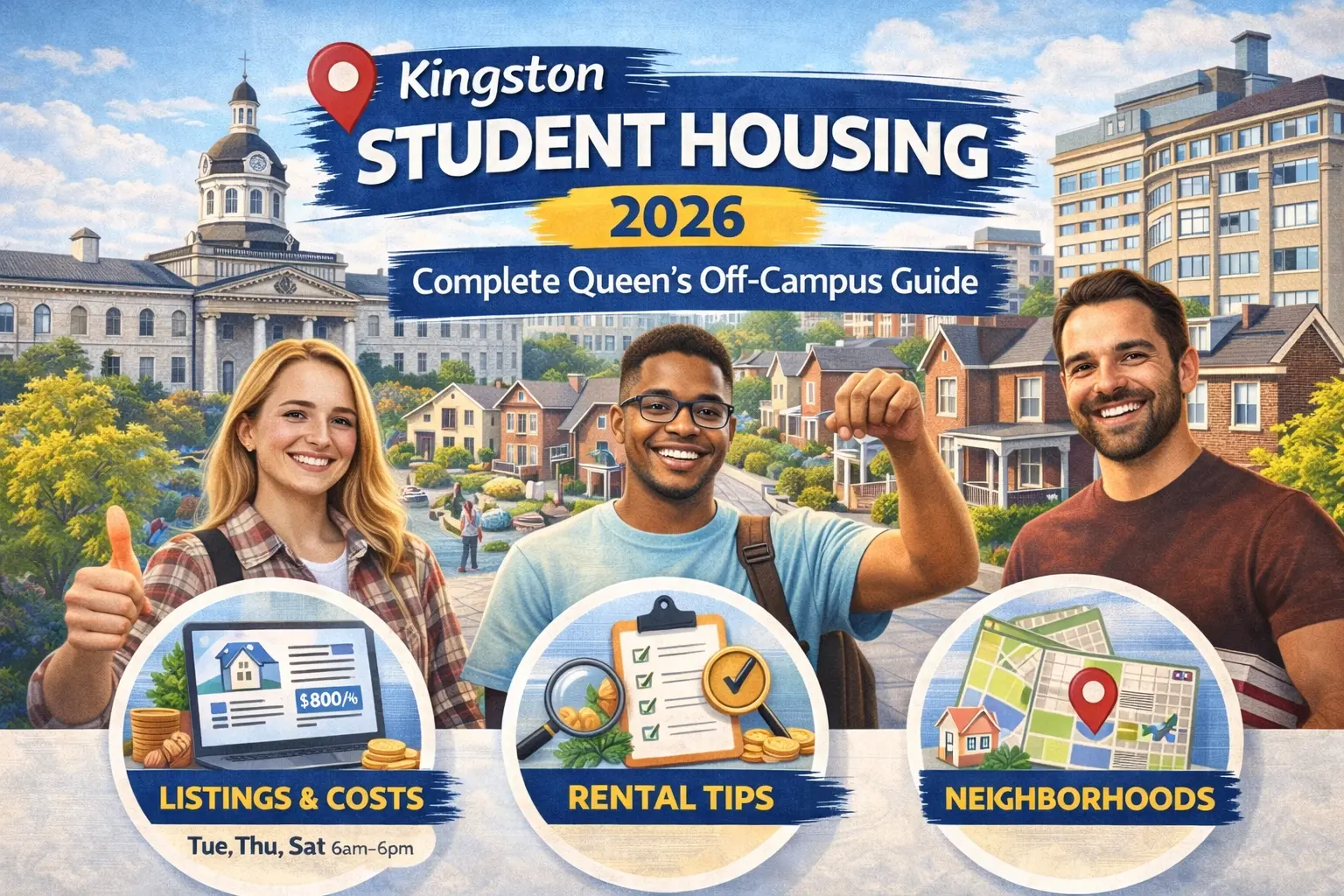
Quick Answer
Choosing the wrong Kingston neighbourhood as a Queen's student means a 25-minute walk in -20°C or a commute to Loyalist you didn't plan for. Here's the honest breakdown of every student neighbourhood near Queen's.
You've been accepted to Queen's. Now comes the housing question that every incoming student eventually googles: should you live in residence, or find something off-campus? And if off-campus, where?
The honest answer is that it depends on your year and what you're optimizing for — but there are clear patterns to what works for different situations, and understanding Kingston's geography makes the decision considerably less intimidating.
First Year: Residence vs. Off-Campus
Most Queen's first-years live in residence for at least one year, and this is generally the right call. The main residences — Victoria Hall, Jean Royce, and the Watts and Gordon-Brockington House complexes — are all within a 5-10 minute walk of main campus. You don't need to navigate Kingston bus routes or sign a lease before you've ever been to the city.
Residence isn't cheap ($10,000-13,000 per year including meal plan for most options), but the cost includes utilities, internet, and meals, and the social density of first-year residence has genuine advantages for meeting people. The Queen's residence application process opens in spring — check the Student Affairs website for deadlines because they're earlier than most students expect.
If you're entering second year or transferring, residence may not be available or may not make financial sense. Off-campus becomes the primary option.
The Student Ghetto: What It Is and Whether to Live There
The "student ghetto" is a real place — not an insult but an actual neighborhood designation in Kingston. It's the residential area bounded roughly by University Avenue to the north, Earl Street to the south, Division Street to the west, and Collingwood Street to the east. Aberdeen, Frontenac, Albert, Barrie, and Mack Streets form the dense core.
The ghetto's advantages: walking distance to campus (10-20 minutes depending on exact location), proximity to the Stauffer Library, an established social ecosystem, and an enormous supply of student-targeted rentals. Most of the major student-to-student Fliku and Facebook Marketplace transactions happen in this area.
The disadvantages: many properties are old and poorly maintained. Landlord quality varies enormously. Some houses have been subdivided well past their intended capacity. The March 31st lease-end date creates an annual scramble. The noise and social environment is intense — good if that's what you want, challenging if you're trying to study in your apartment.
Specific Streets and What to Expect
Aberdeen Street and Frontenac Street: Most expensive ghetto streets, closest to the core, and most social. If you want to be in the middle of everything, these are it. Expect to pay $600-800/month per bedroom in a shared house.
Albert, Barrie, and Mack Streets: Slightly further from the main social hub but still walking distance to campus. Often better value — $500-650/month per bedroom — with marginally quieter environments.
Earl and Johnson Streets (eastern section): Borders between the ghetto and quieter residential areas. Can find good-condition houses with better landlords as you move east away from the student concentration.
University District (north of University Avenue): Directly adjacent to campus. More apartment buildings, higher quality on average, less party culture. Popular with upper-year students and grad students. Higher rents ($750-950/month per bedroom) but includes some quality buildings with proper management.
The Sydenham Ward (Downtown Kingston)
Living downtown — in the blocks between Ontario Street and Princess Street, closer to City Hall — is increasingly popular with upper-year students who have bikes or don't mind a 20-25 minute walk to campus. The neighborhood has better restaurants, bars, and coffee shops within walking distance, and housing quality is often better than equivalent-priced ghetto apartments.
The tradeoff is the commute. A 20-minute walk each way adds up. In Kingston winters, that commute is less pleasant. Factor this in realistically.
When to Start Looking
The Kingston student rental market has an irrational timeline that confuses most students. Properties for September start getting leased in November and December of the prior year. By February, the best properties in the ghetto and university district are gone. Students who start looking in March or April are choosing from what remains, which is often lower quality at similar or higher price.
If you're planning to be off-campus, start looking in November or December. Look at properties around Fliku's rental listings, Facebook groups like "Kingston Rentals" and "Queen's Off-Campus Housing," and Zumper.
Lease Dates and What to Watch For
Most student leases in Kingston run May 1 to April 30. Some run September to August. The May-April lease means you're paying rent for May, June, July, and August — even if you go home for the summer. Subletters exist and the practice is common, but you remain responsible for the unit under the lease.
Before signing anything: check who is responsible for utilities (heat and water are sometimes included; sometimes not). Confirm the presence of laundry in-unit or in-building. Walk the property and note anything in writing before signing — photographing every room on move-in day is the most important step most students skip.
How much does off-campus housing cost at Queen's?
For shared houses in the student ghetto: $550-800/month per bedroom, utilities sometimes included. For apartment buildings in the university district: $750-1,100/month for a one-bedroom or per-room in a shared unit. These range fairly widely based on property condition and exact location.
When should I start looking for off-campus housing in Kingston?
November or December for September occupancy. The market moves earlier than students expect. Good properties in desirable locations are typically gone by late January or February.
Is it better to live in residence or off-campus at Queen's?
Residence is generally better for first year — the social density and logistical simplicity are significant advantages for new students. From second year onward, off-campus is typically more cost-effective and provides more independence. The "right" answer varies by person; both work fine.