Quick Answer
Moving to Kingston for the first time — whether from another province or another country — is one of the more logistically complex things you'll do in your life. Here's the checklist that covers what most guides leave out.
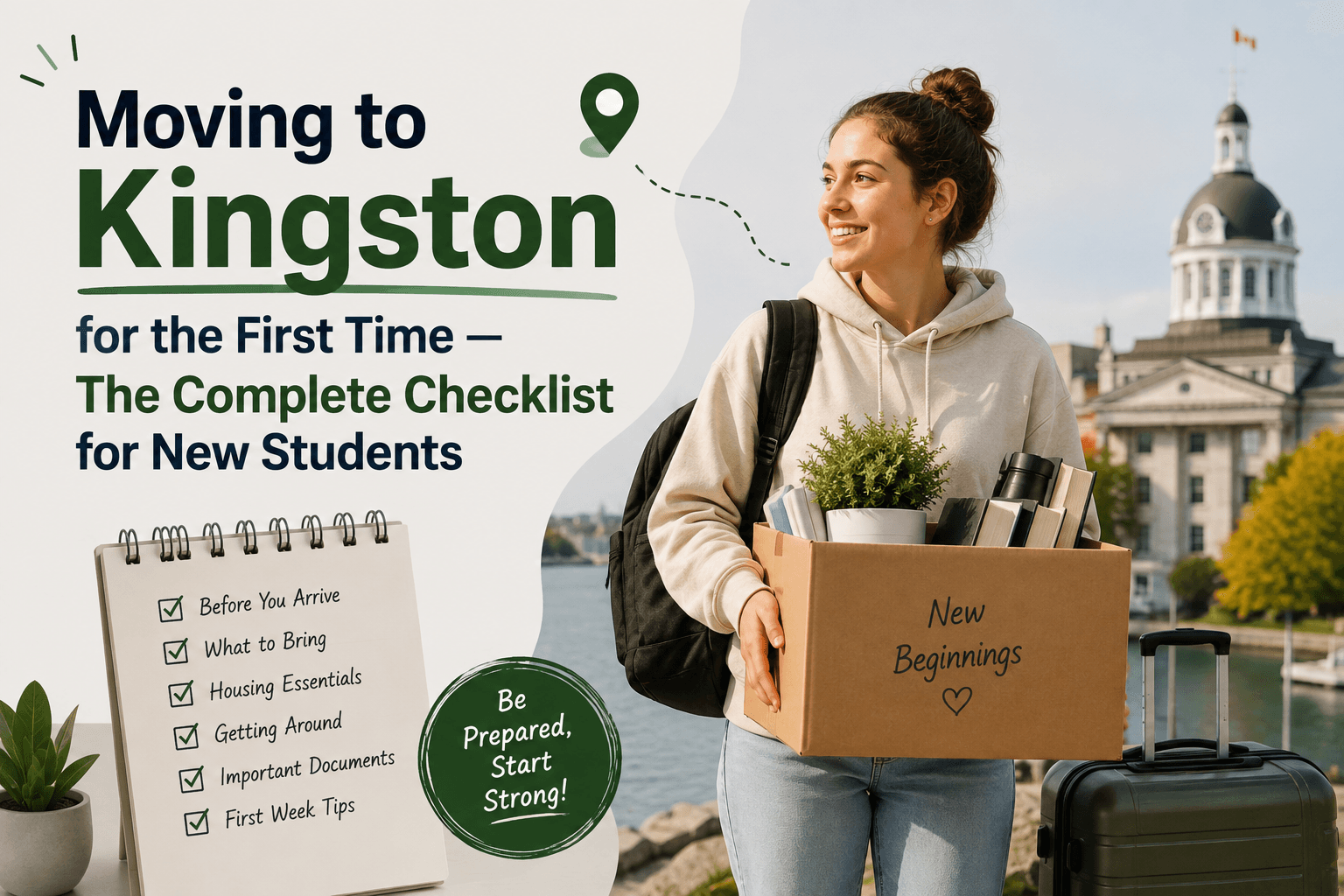
Moving to Kingston for the First Time
The packing guide your parents read says "bring sheets and a good coat." The university orientation materials say "come to campus events and explore your new city." Neither of these is wrong, exactly, but neither tells you that you need to know your bus route before September, or that the good used furniture is gone by August 20th, or that your Ontario health card requires a 90-day waiting period, or that the first week of September is the worst possible time to buy a winter coat in Kingston because every other student is also trying to buy one.
This is the complete checklist. Not the aspirational one — the operational one. What to do before you leave, during your first week, and in the first month.
Before You Arrive — What to Arrange in Advance from Wherever You Are Now
Housing — signed lease with confirmed move-in date. If you don't have this confirmed before you travel to Kingston, arriving without confirmed housing in September is a very stressful situation. The Kingston housing market for students is tight. If you're scrambling for housing in late August, the options are expensive and limited. Confirm your lease, get the address, and know your move-in date before anything else.
Your Queen's or Loyalist student account and NetID. Most of what you need to do before arriving — course enrollment, email activation, library access, parking permits — requires your student account to be active. Activate it as soon as you receive your admission letter. Your NetID is the key to everything at Queen's. If you're having trouble, contact Queen's IT before arriving — don't leave this for September.
Course enrollment. Both Queen's and Loyalist have enrollment windows that open months before September. Enroll in your courses as soon as your enrollment window opens. Popular courses fill. Courses you need for your program progression are sometimes waitlisted. Waiting until August to enroll is how students end up in courses they didn't want because the ones they needed were full.
Used furniture — order it before you arrive. The best used furniture deals in Kingston disappear by mid-August as returning students buy before they move in. If you're moving from far away, this means browsing Fliku and arranging for a friend, family member, or the seller to hold items for your arrival date. A bed frame and a desk are the two pieces you need immediately — source them before September 1st, not on September 1st.
Transit familiarization. Kingston's bus routes connect student neighbourhoods to campus. If your apartment is in the University District, you may be walking distance to class. If you're in Portsmouth near Loyalist College or on the Bath Road corridor, you'll need the bus. Check the route from your apartment to campus on the Kingston Transit website before you arrive.
A bank account in Canada, if you don't have one. For international students and students from outside Ontario: a Canadian bank account is necessary to receive your scholarship payments, pay rent in Canada, and avoid international transaction fees. The major Canadian banks with student accounts in Kingston are RBC, TD, Scotiabank, CIBC, and BMO — all have branches near campus. Open the account online or before you arrive if possible; wait lines at Kingston bank branches in September are long.
What to Bring and What to Buy in Kingston Instead
The decision of what to ship versus what to buy in Kingston is partly logistical and partly financial. Here is the honest version.
Bring without hesitation:
- Personal documents: passport, provincial health card, SIN card, birth certificate, immunization records. These are irreplaceable and should be in your carry-on, not checked.
- Clothing — all of it. Bringing clothes is free; buying them in Kingston is expensive.
- Laptop, phone, and personal electronics. Replace at retail in Kingston only if broken.
- Bedding and towels if you have them and can transport them at low cost. If you're flying to Kingston from another province or internationally, don't pay baggage fees for bedding — buy it used in Kingston for $15-30.
- Any specialized item for your program: lab equipment, art supplies, instruments. These are expensive anywhere and what you already have is already calibrated to you.
Buy in Kingston instead:
- Large furniture: a bed frame, desk, dresser, bookshelf. Shipping furniture across Canada or internationally costs more than buying used in Kingston. Buy on Fliku in August before you arrive, and coordinate delivery or pickup with the seller for your move-in day.
- Kitchen equipment: pots, pans, dishes, cutlery. Universally available used in Kingston for almost nothing. A full kitchen kit from the Salvation Army on Bath Road costs $20-30.
- Winter gear, if you don't own it. Kingston winter requires a real coat, real boots, and a real base layer. Buy these used in Kingston in October — see our full Kingston winter guide. Buying winter gear new is significantly more expensive and September is not the moment to buy it anyway.
- Cleaning supplies, toiletries for first week. Buy these at the Walmart on Bath Road on arrival. They're heavy and available everywhere.
First Week in Kingston — The Administrative Tasks With Actual Deadlines
The first week in Kingston is also orientation week, which means it is simultaneously the most socially busy week of your university life and the week with the highest density of administrative tasks that have actual consequences if missed.
Day 1-2:
- Pick up your physical student card from the Queen's ID Centre (or Loyalist equivalent). Your student card is your building access key, library card, and discount verification — you need it physically before you need it digitally.
- Confirm your residence room or apartment key situation. If anything is wrong with your unit (from your pre-move-in inspection — see our full lease guide), document it on day one.
- Activate Kingston Transit U-Pass if your fees include it. This is done in person at a Kingston Transit location; it doesn't activate automatically.
Day 3-5:
- Attend your faculty orientation — not the general orientation, the specific orientation for your faculty and program. This is where you learn the actual structure of your degree, meet your cohort, and get information relevant to your specific courses. General orientation is optional for most of its content; faculty orientation is not.
- Buy your textbooks. Not from the campus bookstore as a default — from the sources in our used textbooks guide. The cheapest copies of common Queen's textbooks are gone by the end of the first week.
- Set up your student email and Outlook calendar as your primary calendar. Deadlines, exam schedules, and professor communications all go through student email. Getting in the habit of checking it in week one prevents missed deadlines in October.
Before the end of the first month:
- Apply for an Ontario Student Assistance Program (OSAP) grant or loan if you haven't already — deadlines are specific and missing them affects your funding for the year.
- Register with Queen's Accessibility Services if you have a documented disability or learning accommodation need. Do this early — the service is demand-limited and accommodation letters take time to process.
- Open a Canadian bank account if you arrived without one (see below).
OHIP and Health Coverage — The 90-Day Gap Every New Ontario Resident Faces
If you're moving to Ontario for the first time — from another province, another country, or as an international student — there is a health coverage gap that many students don't know about until they need a doctor.
The 90-day OHIP waiting period: New Ontario residents are not covered by OHIP (Ontario Health Insurance Plan) for the first three months after establishing residency. During this period, if you need a doctor, urgent care, or a prescription, you pay out of pocket.
What this means practically: If you arrive in Kingston on September 1st and get sick in October, you are not covered by OHIP until approximately December 1st. A walk-in clinic visit costs $50-150 without insurance. A prescription costs full price. An emergency room visit is covered by OHIP but the ER is not a walk-in clinic.
Your Queen's or Loyalist student health plan covers this gap. The AMS (undergraduate) and SGPS (graduate) health plans at Queen's provide coverage including doctor visits, prescriptions, and mental health support. This coverage begins with your enrollment — it does not have a 90-day waiting period. Download your benefits card from the AMS or SGPS website in your first week. Know what it covers. Use it during the OHIP gap.
Apply for your OHIP card as soon as you arrive. Visit a ServiceOntario location (there are several in Kingston) with proof of identity, proof of Ontario residency (your lease counts), and proof of your legal status in Canada (for international students). The 90-day waiting period starts from the date you apply — the sooner you apply, the sooner OHIP kicks in.
For students from other Canadian provinces: Your home province's health plan covers you for a period after you leave (typically 90-180 days, depending on the province). You can use your home province card during this period — check your province's specific rules. After this period, you need OHIP.
Banking and Money in Kingston
Student bank accounts in Canada: All major Canadian banks offer no-fee student bank accounts. The relevant ones in Kingston with branch locations near campus: TD Canada Trust, RBC Royal Bank, Scotiabank, CIBC, and BMO. All offer student chequing accounts with no monthly fee while you're a student. Features are essentially equivalent — the differentiator is which bank your scholarship or OSAP is deposited to (match your bank to your funding source to avoid delays).
Student credit cards: Building a credit history in Canada matters more than it feels like in first year. A no-fee student credit card (every major Canadian bank has one) used for regular expenses and paid in full monthly builds credit, provides purchase protection, and sometimes earns rewards. Apply for one in September. The absence of a credit history is a problem when you apply for apartments, phone plans, or larger purchases in second year and beyond.
Interac e-Transfer: The Canadian bank-to-bank transfer system used for rent, splitting bills, and peer-to-peer payments in Kingston. It is not Venmo or PayPal — it goes directly between Canadian bank accounts. Every student transaction in Kingston happens through e-Transfer. Know how to send one before your first rent payment is due.
Additional Checklist for International Students Moving to Kingston
Study permit verification — Your study permit must be valid for the duration of your program. Keep physical and digital copies of your permit, Letter of Acceptance, and all immigration documents. Store them separately from each other (one set in your bag, one set in your accommodation, digital copies in cloud storage).
Kingston Police address registration — Not required for all international students, but some study permit conditions include reporting your address to local police. Check your specific permit conditions.
SIN (Social Insurance Number) — Required to work legally in Canada. International students with a valid study permit can apply for a SIN at any Service Canada location. Apply early if you intend to work. Some Kingston employers will not pay you without a SIN on file.
Queen's International Student Services Office (ISSO) — Specific support for Queen's international students on immigration, employment authorization, and navigating Canadian systems. Their website has current information; their office on campus has staff who answer questions specific to your situation. Use this resource — it exists for exactly the questions international students have in the first month.
Phone plan: Canadian mobile phone prices are among the highest in the world for international students accustomed to other markets. Options in Kingston: the major carriers (Rogers, Bell, Telus and their subsidiaries Fido, Koodo, Virgin) all have Kingston coverage. Student-focused plans exist but "student plan" doesn't always mean cheapest — compare the actual price per GB. Flanker brands (Fido, Koodo, Virgin) run $10-20/month cheaper than the parent carrier for equivalent plans. Bring an unlocked phone from home if possible; buying a locked phone in Canada and paying early termination to unlock it is an expensive way to start.
Frequently Asked Questions
What do new students need to do when they first arrive in Kingston?
The first-week priority tasks for new students arriving in Kingston: pick up your physical student card from the ID Centre (needed for building access and library); activate your Kingston Transit U-Pass if your student fees include it (done in person, doesn't activate automatically); document your apartment's move-in condition with photos emailed to your landlord on day one; attend your faculty-specific orientation (more relevant than general orientation); buy used textbooks through Queen's faculty Facebook groups or Fliku before the cheap copies are gone; and apply for your OHIP health card at a ServiceOntario location as soon as possible to start the 90-day waiting period clock. Download your AMS or SGPS student health plan benefits card — this is your coverage during the OHIP gap.
What should students bring when moving to Kingston from another province?
Bring from home: all personal documents (passport, health card, SIN card — in your carry-on, not checked), all clothing, your laptop and personal electronics, and any specialized equipment for your program. Buy in Kingston instead of shipping: furniture (used on Fliku or from the Habitat ReStore), kitchen equipment (Salvation Army has complete kitchen kits for $20-30), bedding and towels (if flying — used in Kingston is $15-25 and not worth paying baggage fees to ship). Winter gear is better bought used in Kingston in October than purchased new anywhere at any time — see the Kingston winter guide for timing and sources. The general rule: anything large, heavy, and available used in Kingston should be bought in Kingston rather than shipped or bought new.
How does health coverage work for students moving to Kingston, Ontario?
New Ontario residents face a 90-day OHIP waiting period after establishing Ontario residency. During this period, walk-in clinic visits, prescriptions, and non-emergency medical costs are not covered by OHIP. Your Queen's AMS or SGPS student health plan covers you from enrollment without a waiting period — download your benefits card immediately and know what it covers. Apply for your OHIP card at a Kingston ServiceOntario location in your first week; the 90-day wait starts from application date. Students from other Canadian provinces can often use their home province health card for 90-180 days after leaving — check your specific province's rules. International students should use their student health plan coverage and confirm its scope with the Queen's ISSO.
What is the best bank for students in Kingston, Ontario?
All five major Canadian banks — TD, RBC, Scotiabank, CIBC, and BMO — have student chequing accounts with no monthly fee and branch locations accessible to Kingston students. The practical differentiators are: which bank your OSAP or scholarship funding is deposited to (match your bank to your funding source), proximity of the branch to your apartment (most are within walking distance of Queen's campus on Princess Street), and any sign-up bonuses the banks are offering in September for new student accounts. Open an account before you need it — September bank lineups in Kingston are long as every new student opens an account simultaneously. All accounts include Interac e-Transfer, which is the payment method used for rent, bill splitting, and all peer-to-peer transactions in Kingston student life.
Is Kingston, Ontario a good city to live in as a student?
Kingston is consistently ranked among the better mid-sized Canadian cities for quality of life, and its student experience reflects this. The city is walkable — most Queen's students live within a 20-minute walk of campus, Princess Street, and the waterfront. The used market is strong for student needs (furniture, bikes, sports equipment, textbooks) because the university population creates consistent supply and demand. The arts and culture offering is larger than a city of 130,000 would suggest: the Isabel Bader Centre, Kingston Symphony, Grand Theatre, the Frontenacs, and active independent restaurant and music scenes. The winters are genuinely cold and require preparation. The housing market is competitive and requires early action. For students who prepare for both, Kingston is a city that holds up well across four years — many Queen's graduates cite it as one of the better places they've lived.
Moving to Kingston for the first time involves more decisions than the orientation packet suggests. The students who arrive prepared — housing confirmed, student account active, OHIP application ready to file, used furniture already sourced — have a materially better first month than the students who arrive and discover all of this in real time. Start with your housing and your student accounts, and use Fliku to handle the furniture and gear before you arrive — Kingston students list specifically for incoming September students who need what they're selling.