Quick Answer
New textbooks at the Queen's bookstore are an optional expense disguised as a requirement. Here's where Kingston students actually buy their course books — and how much they save.
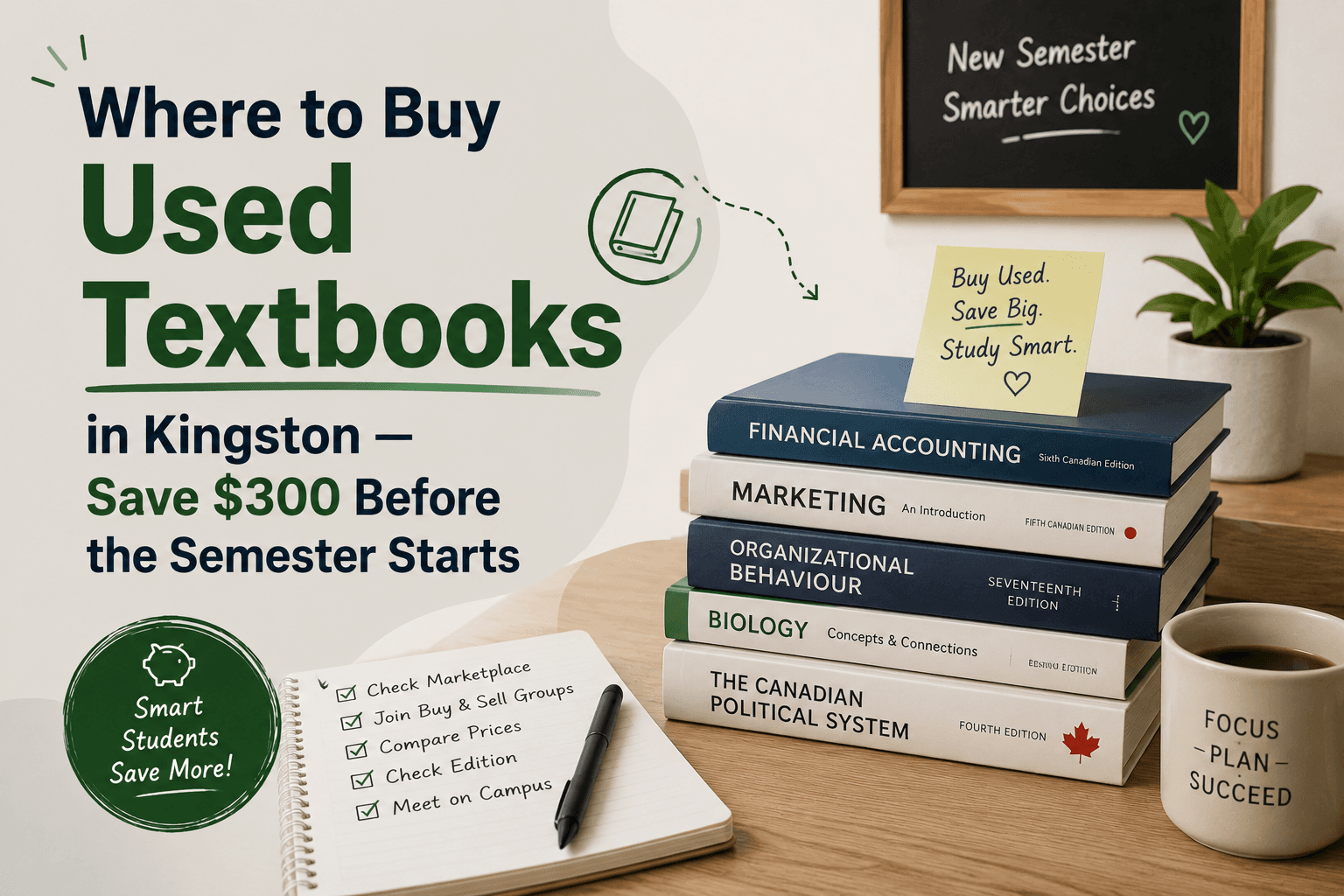
Where to Buy Used Textbooks in Kingston
The Professor marked it "required." The Queen's campus bookstore has it. It costs $187. You need it for a course worth 3 credits. You will use it for 12 weeks and then it will sit on a shelf for two years before you sell it for $40 or leave it on a curb in April.
The $187 new price is not the actual market price. It is the list price, which is what the bookstore charges and what students who don't know the alternatives pay. The actual market price in Kingston — what students who've been here a year know to look for — is $40-80 for the same book, in the same edition, in good enough condition to do every assignment in the course.
Here is where to find it.
The Timing Problem — Why You Need to Start Looking Before Classes Begin
The course syllabus arrives the week before classes, or sometimes on the first day of class. By then, every student in your year is looking for the same three textbooks simultaneously. The students who find them cheapest are the ones who started looking earlier — which requires knowing what the textbook will be before the syllabus is posted.
How to get the textbook list early:
- The Queen's campus bookstore posts course materials online before the semester starts. Go to the bookstore's website (bookstore.queensu.ca), search by course number, and the required texts are listed. Do this in August for September courses. The books are listed; you just don't have to buy them from the bookstore.
- Ask a student who took the course last year. Upper-year students in your program know which courses actually use the textbook and which assign it as "required" while the professor teaches entirely from slides. This information is worth more than any of the strategies below — knowing which textbooks you genuinely need versus which you can skip saves more than buying used.
- Facebook groups for your program year — Post in your Queen's class Facebook group or Discord: "Does anyone have the textbook list for [course]?" This usually gets an answer within hours from someone who took it last year.
Where Kingston Students Actually Buy Used Textbooks
Queen's student Facebook groups and Discord — The highest-volume channel for used textbooks specific to Queen's courses. Every Queen's faculty has its own buy/sell community, and within those, textbook sales are the most consistent transaction type. Search your faculty's group for the course code (e.g., "BIOL 102" or "ECON 111") and you'll often find someone selling the exact book from last semester. Prices run $20-60 for books that cost $150-200 new. The advantage: the seller is a student who used the book for your exact course at Queen's, so you know it's the right edition and you know it gets used.
Fliku's textbook listings in Kingston — Kingston-local used textbook listings from students at Queen's and Loyalist. Post a "looking for" listing with the title, author, and edition if you don't find it in current listings — students who have the book but haven't listed it yet will contact you. Also the right place to sell after the semester ends.
AbeBooks.com — The most comprehensive online used textbook marketplace. International used sellers means prices on AbeBooks are often lower than what Kingston students charge each other, but you're waiting for shipping (3-14 days depending on seller location). For books you know you'll need and can identify early, AbeBooks is consistently the cheapest source — $8-35 for books that cost $150+ new, including shipping. The risk: shipping time. Order by August 25th for September 1st start dates.
ThriftBooks.com — Similar to AbeBooks with free shipping on orders over $15. Slower shipping than Canadian sellers (US-based), but prices are extremely low for common textbooks in older editions. Best for courses where you've confirmed the previous edition is acceptable.
Chegg Textbook Rental — Renting rather than buying: Chegg rents physical textbooks for $15-60 per semester depending on the book. For a course you know you'll never reference again after the exam (and most courses are this), renting is cheaper than buying and eliminates the selling problem at the end. The trade-off: you can't highlight or annotate heavily (or you pay a damage fee).
Campus bookstore — used section — The Queen's bookstore sells used copies of required textbooks when they're available. The selection is limited (they don't always have used inventory) and the used price is 25% below new, which is a discount but not the discount available on Facebook or AbeBooks. If the book is in the used section and you need it immediately, the bookstore's used copy is fine. As a first stop, it is not.
The Edition Question — When You Need the New Edition and When You Don't
Publishers release new textbook editions to force students to buy new copies — the old editions are no longer "correct," the homework problems are renumbered, and the bookstore carries only the new version. This is the textbook industry's most effective revenue mechanism. Understanding when a new edition genuinely matters versus when it doesn't determines whether you can buy an older, cheaper edition or need the current one.
New edition genuinely required — buy current:
- Any textbook where the professor assigns problems by chapter and problem number — if the editions have different problem sets, you'll be on the wrong problems for every assignment
- Law, medicine, nursing, and clinical programs where regulations and protocols change
- Any course with an online access code bundled into the new edition — if the online component is required and graded, you need the current edition
Older edition is fine — buy previous edition:
- Core science and mathematics textbooks (physics, calculus, chemistry) — the content doesn't change between editions; only the problem numbering and examples shift. Get the problem set from a classmate with the new edition and work from the older book.
- Humanities and social science readings — if you're assigned chapters to read, the content is essentially identical across recent editions. Buy the edition two or three generations back for $5-15.
- Any course where the professor says "it's in the course readings package" — if the relevant material is excerpted into a course pack, the textbook is background reference and edition doesn't matter.
How to verify: Email the professor or teaching assistant directly before the semester starts: "I found a copy of the Xth edition at a lower price — is that edition sufficient for the course assignments?" Professors answer this question directly and honestly. If the answer is yes, you've saved $80-150.
Digital Alternatives That Cost Less Than Used Physical Books
VitalSource and Chegg eTextbooks — Publishers sell digital versions of textbooks for semester access at $30-70, which is often less than a used physical copy and significantly less than new. The advantages: instant access (no shipping wait), searchable text, accessible on any device. The disadvantage: you don't own it — access expires at semester end and it can't be resold.
Google Scholar and open access journals — For courses where the "textbook" is primarily academic papers, Google Scholar often provides free access to the same papers through open access versions, university repository uploads, or preprint servers. Check Google Scholar before paying for any journal article. Queen's library access also covers most academic databases — use the Queen's library portal to access journal content you'd otherwise pay for.
Library Genesis (Libgen) — A legally complicated but widely used repository of academic texts. Students use it; the legality under Canadian copyright law for personal academic use is genuinely unclear. We mention it because it exists and students use it — but it's not a recommendation.
Scribd student plan — $9.99/month for access to Scribd's library, which includes a large number of academic and professional texts. If multiple of your required books are in Scribd's library, a one or two month subscription covers your semester reading for less than any single textbook purchase.
What the Queen's Library Actually Provides
The Queen's library system is systematically underused by students who don't know what it contains. Before you buy any textbook, check these three things:
Course reserves: Professors can place textbooks on reserve at Stauffer Library — physically available for a two-hour loan at the library desk. Many required textbooks are on course reserve. You cannot take them home, but you can read and photograph the relevant chapters during a library session. This is legal, common, and used by a significant number of Queen's students.
E-book access through Queen's library: The Queen's library licenses digital access to a large number of academic titles. Many textbooks you'll encounter in courses are available as e-books through the library portal — free, unlimited access for current students. Search the Queen's library catalogue by title before purchasing any textbook. The hit rate varies by discipline, but it's nonzero and worth the two-minute search.
Interlibrary loan: If a book isn't in the Queen's collection, the library can often borrow it from another Canadian university. This takes 1-2 weeks — useful for research assignments, not for a textbook you need on day one. Plan ahead for anything you know you'll need mid-semester.
Selling Your Kingston Textbooks at the End of the Semester
The ideal time to sell is before the exam, not after. Students who still need the book to study for finals are your buyers. Students who've finished their finals and are packing to leave Kingston are not buyers — they're the competition.
Post in the Queen's course-specific Facebook group and on Fliku in the last two weeks of classes. Price at 40-55% of new retail for a book in good condition — this is the price point that sells quickly versus the price that sits and then gets left behind. A book that sells for $55 in April is better than a book that sits at $75 until you leave it on the curb.
For books that don't sell locally, AbeBooks and Chegg both have textbook buyback programs — the prices are lower than private sale but they take the book off your hands with a prepaid shipping label. Better than nothing, worse than finding a local buyer.
Frequently Asked Questions
Where can Queen's University students buy used textbooks in Kingston?
The best sources for used textbooks in Kingston, ranked by typical price and speed: (1) Queen's faculty Facebook groups and Discord servers — search the course code and find students who took it last year, typically $20-60 for books costing $150+ new; (2) Fliku Kingston — local listings from Queen's and Loyalist students; (3) AbeBooks.com — the cheapest prices overall for used physical copies including international sellers, $8-35 with shipping, but requires 3-14 day lead time; (4) Chegg textbook rental if you won't need the book after the course, $15-60/semester; (5) The Queen's campus bookstore used section, at 25% below new, as a last resort when other options are exhausted. Start looking in August for September courses — the best used copies are gone by the first week of class.
Do I need the newest edition of a textbook for Queen's University courses?
Not always — and the answer is worth checking before buying the new edition at full price. Courses that assign specific problem numbers from the textbook require the current edition because problem sets change between editions. Courses where you're reading chapters for content (not doing textbook problems) are usually fine with the previous edition, since the core content doesn't change. The simplest verification: email the professor or TA before the semester and ask directly whether the previous edition is sufficient. Professors answer this question honestly. A "yes" saves $80-150 on a single textbook. Also check whether the course has an online access code requirement — if so, you need the new edition regardless of content similarity.
Can Kingston students rent textbooks instead of buying?
Yes — Chegg rents physical textbooks shipped to Kingston addresses, and digital renting is available through VitalSource and Chegg eTextbooks. Rental prices for a semester are typically $15-60 for physical books and $30-70 for digital access, compared to $150-220 for new purchase. Renting makes financial sense for courses where you know you won't reference the book after the final exam (most courses) and where you don't plan to heavily annotate (physical rental condition requirements apply). The downside is that you can't resell a rental at the end of the semester — if you bought used and sell at the end, your net cost after sale is often comparable to rental. Renting is better for tight cash flow at the start of semester; buying used and selling is better overall if you manage the timing.
Are textbooks available in the Queen's University library?
Yes — in two ways. First, many required textbooks are placed on course reserve at Stauffer Library by professors, available for 2-hour in-library loans at the service desk. You can read and photograph relevant chapters during a library visit without buying the book. Second, the Queen's library licenses e-book access to a significant number of academic titles — search the library catalogue by textbook title before purchasing anything; if it's available as an e-book, you have unlimited digital access for free as an enrolled student. Interlibrary loan is available for books not in the Queen's collection, with a 1-2 week wait. Course reserve and library e-book access together mean some students complete courses without buying any books — but you need to check availability course by course, not assume.
How much money can students save buying used textbooks at Queen's?
A Queen's student carrying a full course load of five courses per semester typically faces a new textbook list costing $400-800 per semester if purchased at list price from the campus bookstore. The same books bought used — through faculty Facebook groups, Fliku, and AbeBooks — typically cost $150-300. The saving is $250-500 per semester, or $500-1,000 per academic year. Students who additionally identify courses where older editions work, use Queen's library course reserves, and skip textbooks confirmed as rarely used by upper-year students can bring their per-semester textbook cost below $100 with advance planning. The advance planning is the variable — students who start looking in August save more than students who buy in September desperation after the cheap copies are gone.
The Kingston textbook market works in your favour if you know it. The students paying $800 a semester for textbooks are the students who went to the bookstore website, saw "required," and bought it without checking what the book costs anywhere else. Check the Queen's library first, check the faculty Facebook groups second, check AbeBooks third. Fliku's Kingston textbook listings connect you with the student who took your exact course last semester and has the exact book you need. And when you're done with it, sell it there before the exam period ends — that's when your buyers are.