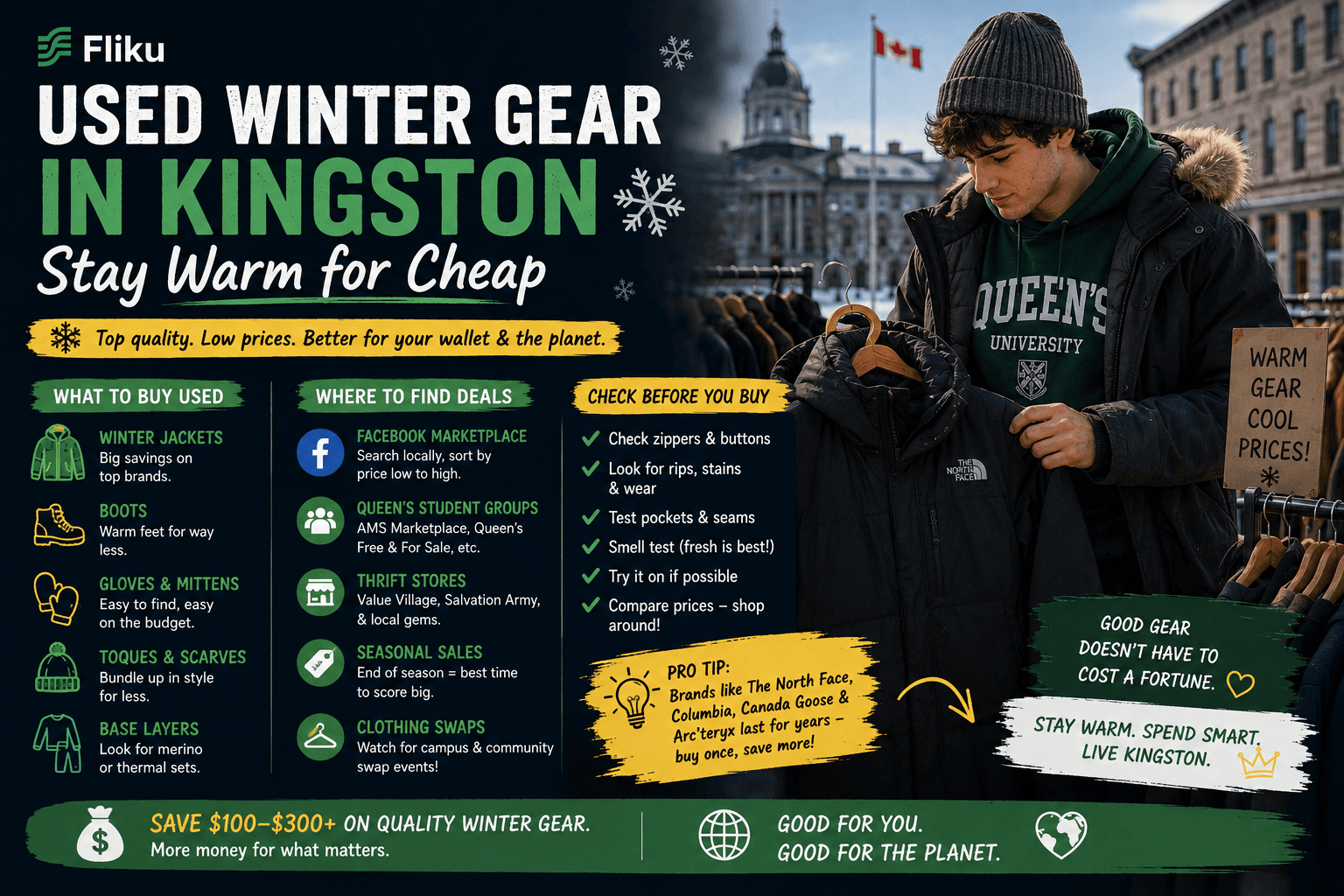
Quick Answer
Kingston winters hit -20°C with Lake Ontario wind. If you're arriving from somewhere warmer, you are not ready. Here's how to get fully kitted for a Kingston winter for under $120 buying used.
Used Winter Gear in Kingston
Nobody tells you about the wind.
You've seen -15°C before. Maybe you grew up in southern Ontario and you think you know cold. But Kingston sits at the eastern end of Lake Ontario, and in January and February the wind comes off that lake and hits Princess Street like something personal. It's not just the temperature — it's the temperature combined with wind chill combined with walking fifteen minutes to a lecture hall at 8:30 in the morning in the dark.
Students who arrive in Kingston from Vancouver, from international climates, even from Toronto, get through October thinking their jacket is fine. November disabuses them of this idea. By December they are spending $300 at the outfitters on Princess Street because they've run out of cold to tolerate and they need a solution today.
That $300 can be $80-120 buying used — if you do it before the cold hits rather than during it.
What You Actually Need for a Kingston Winter
This is not a hypothetical list. This is what keeps you functional — able to walk to class, bike to the grocery store, stand at a bus stop — when Kingston is doing what Kingston does from November through March.
The non-negotiables:
A genuinely warm parka. Not a winter jacket. A parka — insulated, rated for real cold, long enough to cover your hips. The test: if you put it on inside your warm apartment and don't immediately feel slightly too hot, it is not warm enough for Kingston. Canada Goose and Arc'teryx are the gold standard. The North Face, Columbia, and Eddie Bauer are solid alternatives. Uniqlo ultralight down is a Kingston student trap — it's warm enough for -5°C and completely insufficient for -20°C.
Waterproof winter boots. Not sneakers. Not fashion boots with a thin sole. Sorel, Kamik, or Baffin boots rated to -30°C or below. The roads and sidewalks in Kingston are not properly cleared between December and March. You will walk through slush, over ice, through packed snow. Shoes that aren't waterproof make you miserable. Boots that aren't warm enough mean cold feet in every lecture.
Thermal base layers. Two sets of thermal underwear (top and bottom). Merino wool is ideal and available used for very little. Synthetic thermals work fine and are cheaper. You wear these under everything else — they add 10-15 degrees of warmth for almost no additional bulk.
A proper hat and gloves. Not a beanie. A hat that covers your ears. Gloves that go past your wrists. The wind in Kingston is the part that gets you — exposed ears and wrists are where the cold finds you fastest.
The additions that make winter livable (not just survivable):
- A wool or fleece mid-layer (worn under your parka)
- Wool socks — three or four pairs minimum
- A neck gaiter or scarf — Princess Street wind exposure is real
- Hand warmers for particularly bad days
What Used Winter Gear Costs in Kingston
| Item | Used Price (Kingston) | New Price |
|---|---|---|
| Canada Goose / Arc'teryx parka | $150–280 | $600–1,200 |
| North Face / Columbia parka | $40–80 | $200–400 |
| Sorel / Kamik winter boots | $30–65 | $140–220 |
| Wool / fleece mid-layer | $15–30 | $60–120 |
| Thermal base layers (top + bottom) | $10–25 | $40–80 |
| Winter hat + gloves | $5–15 | $30–60 |
| Full setup (standard brands) | $100–215 | $470–880 |
When to Buy — Don't Wait Until You're Already Cold
This is the mistake that costs Kingston students money every year. Waiting until you're cold means buying in November or December when:
- Supply of used winter gear in Kingston is low — sellers have already sold before the cold hit
- You have no time to compare or negotiate — you need a coat today
- New gear is expensive and the stores know demand spikes in winter
Buy in August or early September. This is when outgoing Kingston students who bought quality winter gear and are now leaving sell it. Supply is high, they are motivated to sell before they leave, and you have time to be selective. A North Face parka bought in August for $55 is the same coat you'd spend $80+ on in November when you're desperate and cold.
If you're reading this in October or November: buy now, not later. The cold in Kingston does not wait for you to get organized.
Where to Find Used Winter Gear in Kingston
Fliku's clothing and gear listings in Kingston are the best place to start for winter coats and boots specifically. The volume of winter gear listings peaks in August and early September as outgoing students clear out. Search for your specific needs — "parka," "winter boots," "Sorel" — and check back daily. Good winter coats in Kingston sell within 48 hours of listing.
Other sources worth knowing:
- Queen's University Buy & Sell Facebook group — winter gear consistently listed here by students who are leaving Kingston or upgrading. Check in August and September.
- Value Village on Bath Road — Kingston's Value Village consistently has winter coats in good condition at $20-40. The quality varies visit to visit — worth checking in August when summer donations include winter gear people cleared out.
- Salvation Army on Bath Road — similar to Value Village for winter coats. Boots are rarer here but worth a look.
- Your building's Facebook or WhatsApp group — someone in your building is leaving Kingston and has a winter coat they can't take. Ask in late August.
What to Check Before Buying Used Winter Gear
For parkas and winter coats:
- Check the fill. Down coats should feel evenly filled — no flat spots where the down has clumped or migrated. Flat spots mean cold spots.
- Check the shell. The outer fabric should be intact — no tears, no worn-through spots at the shoulders or cuffs where abrasion is highest.
- Check the zipper. Zip it fully up and down. A zipper that catches or sticks is a problem in -20°C when you're fumbling with gloves on.
- Check the cuffs and hem. These areas show wear first. Heavy pilling or fraying at the cuffs means the coat has had significant use.
- Smell it. A coat that smells of mildew has been stored damp. It may not air out fully.
For winter boots:
- Check the sole. The lug pattern on the sole should be clear and deep — worn flat soles mean poor traction on Kingston's icy sidewalks.
- Check the waterproofing seam. Look at the join between the upper and the sole — any separation means water will get in.
- Check the lining. Sorel and Kamik boots have removable felt liners — take them out and check for moisture damage or mould smell.
- Try them on with thick socks. Winter boots that fit with thin socks will be too tight with wool socks and will reduce circulation, making your feet colder.
The Kingston Student Layering System That Actually Works
The students who are comfortable in Kingston winters are not necessarily wearing the most expensive gear. They are wearing the right layers in the right order.
Layer 1 — Base (thermal underwear): Against your skin. Traps body heat, wicks moisture. Merino wool is warmer and odour-resistant but more expensive. Synthetic is cheaper and works well for most situations.
Layer 2 — Mid (fleece or wool sweater): Over your base layer. Adds insulation. This is what you wear inside once you take your coat off — it has to be comfortable as a standalone indoor layer as well as functional under a coat outdoors.
Layer 3 — Shell (parka): Wind and waterproof outer layer. This is where you spend your money. A good parka makes the two layers underneath significantly warmer than they would be exposed to Kingston wind.
Extremities: Warm hat covering ears. Neck gaiter. Gloves with insulation (not just leather). Wool socks. These areas lose heat faster than your core and are often what makes a Kingston winter feel unmanageable when they're inadequate.
Kingston's weather emergency resources are worth knowing as well — the city issues cold weather advisories when conditions are particularly severe, and knowing when to stay in is part of managing a Kingston winter sensibly.
Frequently Asked Questions
How cold does Kingston, Ontario get in winter?
Kingston regularly reaches -15°C to -20°C in January and February, with wind chill often pushing the feels-like temperature to -25°C or below. The city's position at the eastern end of Lake Ontario creates consistent lake-effect wind that makes even moderate temperatures feel significantly colder — particularly on exposed streets like Princess Street downtown and along the waterfront. A standard winter jacket that works in Toronto is genuinely insufficient for a Kingston winter. A parka rated to -30°C or below is the appropriate minimum for a Kingston student spending time outdoors.
Where can I buy used winter gear in Kingston, Ontario?
Fliku is the best starting point for used winter coats and boots in Kingston — all listings are local, inventory peaks in August and September when outgoing students sell before leaving, and you can coordinate pickup without shipping. The Queen's University Buy & Sell Facebook group has consistent winter gear listings in late summer. Value Village and the Salvation Army on Bath Road stock winter coats at $20-40 with varying quality. Your building's community group is worth asking in August — departing tenants with winter gear they can't transport are common.
What winter gear do I need as a Queen's University student in Kingston?
The non-negotiables for a Kingston student winter are: a properly insulated parka (not a regular winter jacket) rated to -25°C or below, waterproof winter boots with a warm liner (Sorel or Kamik are the standard recommendations in Kingston), thermal base layers for both top and bottom, a hat that covers your ears, and gloves with real insulation. Wool socks and a neck gaiter are important additions. This complete setup costs $100-215 buying used in Kingston's secondhand market versus $470-880 buying new — the used route covers you fully for a fraction of the price.
When should I buy winter gear in Kingston as a new student?
Buy in August or early September — not in November when you're already cold. This is when the supply of used winter gear in Kingston is highest, as outgoing students sell everything before leaving at end-of-lease dates. Prices are competitive, you have time to inspect carefully and compare options, and sellers are motivated. Students who wait until the cold hits pay higher prices, have fewer options, and often make rushed decisions on gear that doesn't actually fit them well. The Kingston cold arrives in October and doesn't leave until April — being prepared before it hits is genuinely worth the planning.
How much should I spend on a used winter coat in Kingston?
For a standard quality brand (The North Face, Columbia, Eddie Bauer) in good condition, $40-80 is a fair price in Kingston's used market. For premium brands (Canada Goose, Arc'teryx) in excellent condition, $150-280 is realistic and still significantly below new retail prices of $600-1,200. Anything priced above $80 for a non-premium brand should be in excellent condition — minimal wear, intact fill, working zipper, no damage. Below $40 for a standard brand usually means visible wear or problems — inspect very carefully at that price point and confirm the coat actually functions as advertised before paying.
Kingston winter is survivable — comfortably survivable — with the right gear. And the right gear does not have to cost you $400 new when the same protection is available used for a quarter of the price. Browse used winter coats and boots on Fliku in Kingston and get sorted before September ends. Or post a wanted ad specifying your size and what you need — Kingston sellers respond fast and winter gear is one of the most actively traded categories in the city.