Quick Answer
Kingston hydro bills spike in winter. Most student apartments are older and poorly insulated. Here's exactly how Kingston students cut their utility costs without freezing.
Lower Your Utility Bills in a Kingston Apartment
Your first Kingston hydro bill after January is a shock if nobody warned you. January in Kingston is genuinely cold — regularly -15°C to -20°C, sometimes colder with wind chill — and the older Victorian and Edwardian houses that make up most of the student housing in the University District and Sydenham Ward were not built with modern insulation standards. The furnace runs. The drafts find you. The bill arrives.
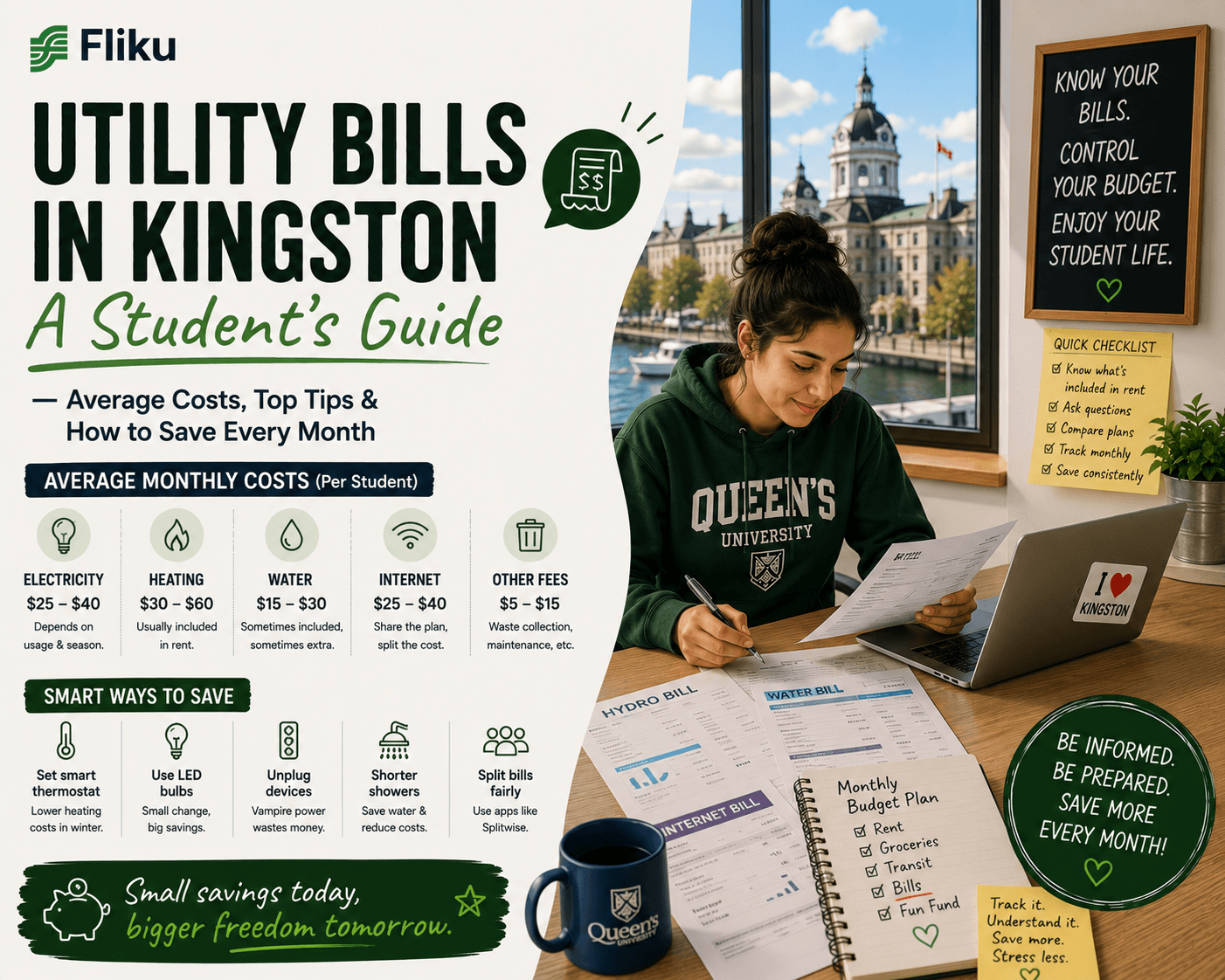
A typical shared Kingston student house pays $150-250/month in hydro through the winter months, split among two to four students. That's $40-80 per person per month, on top of rent, food, and everything else. There are real, practical ways to cut this — not through discomfort but through understanding where the heat and money are actually going.
Understanding Your Kingston Utility Bill
Before you can reduce the bill, you need to understand what's on it. Kingston is served by Kingston Utilities (for water) and Hydro One or Kingston Hydro for electricity, depending on where exactly your apartment is located. Most student apartments include heat (gas or electric) in the rent, or charge it separately. Know which situation you're in before you try to manage it.
If heat is included in your rent: Your landlord controls the heating system. In Ontario, landlords are required to maintain a minimum temperature of 20°C from September 15 to June 1. If your unit is cold and the landlord isn't maintaining this, that's a maintenance issue — contact your landlord in writing first, then Ontario's Landlord and Tenant Board if unresolved.
If utilities are in your name: You have control and you bear the cost. This is where the strategies below apply directly.
Heating — Where Most of the Money Goes
Heating accounts for 55-65% of a Kingston student apartment's winter utility costs. This is the lever that matters most.
Set a consistent thermostat temperature and leave it. The myth that turning the heat all the way down when you leave and all the way up when you return saves money is wrong. Your furnace works harder to recover from a cold house than to maintain a consistent temperature. Set it to 18-19°C when you're out and 20-21°C when you're home. The difference in comfort is significant; the difference in cost is minimal compared to the on-off cycling approach.
Zone your heat if you have baseboard heaters. Many Kingston student apartments — particularly in older houses — use electric baseboard heaters rather than a central furnace. The advantage: each room has its own thermostat. Turn down the heat in bedrooms during the day (18°C is fine when nobody's in the room) and in the living room overnight. This alone can cut a baseboard heating bill by 15-25%.
Your bedroom door matters. Keeping bedroom doors closed when you're sleeping or studying keeps the heat you generate in the room and reduces how hard the baseboard heater has to work to maintain temperature. Simple and free.
Sealing Drafts in an Older Kingston House
This is the single most cost-effective thing a Kingston student can do in a drafty older house — and most older houses in the University District and Sydenham Ward are drafty. Cold air enters through window gaps, door frames, and electrical outlets on exterior walls. Heat escapes the same way.
Draft snakes for doors: A rolled towel at the bottom of an exterior door costs nothing and blocks a meaningful amount of cold air. Actual draft snakes cost $10-15 at any Kingston hardware store and last indefinitely.
Window insulation film: Available at Canadian Tire on Bath Road for $15-25 per window. It's a plastic film you apply to the inside of single-pane windows with double-sided tape and then shrink with a hair dryer. It creates a dead air space that dramatically reduces cold transfer. In a Kingston house with single-pane windows — which is most of the University District housing stock — this is the highest-impact cold-weather upgrade available to tenants. Install it in October before the real cold hits.
Outlet insulators: Foam gaskets that go behind electrical outlet covers on exterior walls, available for $5-8 for a pack of ten. Electrical outlets on exterior walls are small but consistent sources of cold air infiltration in older Kingston houses. Takes 20 minutes to install across a whole apartment.
Check with your landlord before making any modifications — most of these are fully removable and non-damaging, but it's good practice to confirm.
Hydro One Time-of-Use Rates — The Kingston Student Advantage
If your Kingston apartment is on Hydro One's time-of-use pricing (check your bill — it will say), electricity costs different amounts at different times of day:
- On-peak (most expensive): Weekdays 7am-11am and 5pm-7pm
- Mid-peak: Weekdays 11am-5pm
- Off-peak (cheapest): Weekdays 7pm-7am, and all day weekends and holidays
Students have a structural advantage here: you're often not home during on-peak hours (you're at class or the library), and you can shift high-draw activities to off-peak without significant lifestyle change.
Run your dishwasher, washing machine, and dryer after 7pm on weeknights. A full laundry cycle run at 8pm instead of 6pm costs meaningfully less on time-of-use pricing. Over a month this adds up. Over an eight-month academic year in Kingston it's a real number.
Charge your laptop and phone overnight. Off-peak all the way. This is free money — you're asleep anyway.
Appliances and Small Changes That Add Up
Your fridge is always on. If your shared house has an old second fridge in the basement — common in Kingston student houses where a previous tenant left one behind — unplug it if it's not being used. An old inefficient fridge running empty in a cold basement costs $10-20/month in electricity for no benefit.
LED bulbs. If your Kingston rental has incandescent or CFL bulbs (many older units still do), replacing them with LED costs $5-8 per bulb and cuts lighting electricity use by 75%. Ask your landlord if they'll cover the cost — many will, because it benefits the unit long-term.
Power bars with switches. TVs, gaming consoles, and speaker systems draw standby power even when off. A power bar with a switch for your entertainment setup costs $15 and lets you cut all standby draw with one switch before bed. Not a massive saving, but consistent.
Shorter showers. If you're on a metered water plan where you pay for usage (check your lease — some Kingston student houses have this), shower duration directly affects your water bill. A 5-minute shower versus a 12-minute one is a meaningful difference over a month with multiple residents.
Internet and Other Bills
Kingston student apartments typically pay for internet separately. Rogers and Bell are the dominant providers in Kingston's student neighbourhoods, but smaller providers like TekSavvy and Distributel resell on the same physical infrastructure at significantly lower prices.
A Rogers or Bell "student plan" in Kingston runs $70-90/month. TekSavvy on the same cable infrastructure runs $45-60/month for equivalent speeds. The switch takes a phone call and usually saves $25-35/month — split four ways among roommates, that's modest, but over eight months it's $200-280 in total household savings.
Check Kingston's utility information pages for rebate programs — Ontario has periodic energy efficiency rebate programs that apply to window film, insulation, and other upgrades, some of which are accessible to tenants with landlord consent.
Frequently Asked Questions
How much are utilities for a student apartment in Kingston, Ontario?
A typical Kingston student apartment pays $150-250/month in combined hydro and heat through the winter months (November-March), split among two to four students. Per-person costs run $40-80/month in winter and $20-40/month in the warmer months. Older Victorian and Edwardian houses in the University District tend toward the higher end due to poor insulation and single-pane windows. Students who seal drafts with window film and outlet gaskets, use time-of-use electricity pricing strategically, and zone their baseboard heat typically cut winter bills by 20-35%.
How do Kingston students lower their hydro bills in winter?
The highest-impact strategies for lowering hydro bills in a Kingston student apartment are: installing window insulation film on single-pane windows ($15-25 per window at Canadian Tire), sealing door drafts with draft snakes, zoning baseboard heaters by room rather than heating unoccupied spaces, and shifting high-draw appliances (laundry, dishwasher) to off-peak hours after 7pm on weekdays. Collectively these changes typically reduce a Kingston student apartment's winter utility costs by 20-35% with an upfront investment of $30-80 in materials.
Are utilities included in Kingston student apartment rent?
It varies by landlord and unit. Many Kingston student house rentals include heat but not electricity or internet. Some include all utilities. Some include none. Read your lease carefully — the utility clause is usually in the first two pages. If you're viewing a unit, ask explicitly what's included and what the average winter utility cost has been for previous tenants. A landlord who won't answer this question directly is hiding a high number. A unit that "includes heat" in an older Kingston house with electric baseboard heaters may still have significant hydro costs from everything else you use.
What is the cheapest internet provider for students in Kingston?
TekSavvy and Distributel are consistently cheaper than Rogers and Bell for internet in Kingston while using the same physical cable or DSL infrastructure. TekSavvy cable internet in Kingston runs $45-60/month for speeds comparable to Rogers plans at $70-90/month. The signup process involves a phone call and a 2-3 week setup period. Worth doing at the start of the year — the annual saving on a shared Kingston student apartment internet bill is $200-350 versus going with the major carriers directly.
How cold do Kingston student apartments get in winter?
In older Kingston student houses — which is most of the housing stock in the University District and Sydenham Ward — indoor temperatures in poorly maintained units can drop to 16-18°C in the coldest January and February nights without adequate heating. Ontario law requires landlords to maintain a minimum of 20°C from September 15 to June 1. If your Kingston apartment is consistently below this and your landlord isn't responding, document it in writing and contact the Landlord and Tenant Board. In the meantime: window insulation film, draft snakes, and a space heater in your bedroom (used carefully) are the practical stopgaps.
Utility costs in Kingston are one of the more controllable parts of the student budget — a few hours of weatherproofing in October and some habit changes around appliance use make a real difference over an eight-month winter. If you're furnishing your Kingston apartment on a budget, browse used furniture on Fliku — getting your setup costs low in September means more room in the budget for the winter bills that are coming regardless.