Quick Answer
Not a survival guide. A real plan for eating well on a tight student budget in Kingston — with specific grocery stores, actual prices, and meals you'll want to eat again.
How Kingston Students Eat Well on $50 a Week
The first three weeks of September you eat out. The food is easy, the city is new, and meal prep sounds like something you'll start doing once you're settled. By October you check your bank account and realize you spent $400 on food last month and have nothing to show for it except some mediocre pasta from a restaurant on Princess Street.
Fifty dollars a week for groceries — $200 a month — is a genuine Kingston student food budget for someone who cooks. Not a punishment budget. Not rice and canned beans. Actual food that you want to eat, with enough variety that you don't lose your mind by November. Here's how it works.
Where Kingston Students Actually Shop to Spend Less on Groceries
The grocery store you use determines 40% of your food budget before you've bought a single thing. This is not an exaggeration. The same cart of food costs meaningfully different amounts depending on where you buy it in Kingston.
No Frills (Princess Street) — The highest-value grocery store available to Queen's students within walking or busing distance. No Frills operates on a discount model: no frills means no samples, no elaborate displays, no brand names positioned at eye level. It means lower prices. A weekly basket of chicken thighs, eggs, onions, canned tomatoes, pasta, oats, bananas, and frozen vegetables costs $35-45 at No Frills. The same basket at a full-service grocery store costs $50-65. Learn where this store is in the first week. Make it your default.
Food Basics — Another discount grocery option in Kingston. Similar price positioning to No Frills. Both stores run weekly specials that are genuinely significant — check the flyer before you go (the Flipp app shows all Kingston grocery flyers in one place) and build your week around what's on sale.
Walmart Supercentre (on Bath Road) — For non-perishables specifically: oats, canned goods, pasta, rice, oil, soy sauce, peanut butter, and anything with a long shelf life, Walmart's prices undercut every grocery store in Kingston. A 4L jug of olive oil at Walmart is cheaper than the same volume at any grocery store. A 10kg bag of rice is approximately $12-15. These staples bought at Walmart and restocked monthly rather than weekly significantly reduce the baseline cost of cooking in Kingston.
The Kingston Public Market (Springer Market Square) — Open Tuesdays, Thursdays, and Saturdays. Fresh vegetables and fruit from local farmers are competitive with or cheaper than grocery store prices in season (May-October). Tomatoes, peppers, corn, apples, and whatever is in season are excellent here. Out of season (November-April), the grocery store wins on price. In-season produce from the market is noticeably better quality, which matters for whether you actually eat the vegetables you bought.
What to avoid for price: Loblaws and Metro are the premium-tier grocery stores in Kingston. They have better prepared foods, nicer displays, and higher prices across the board. Fine for a specific ingredient you can't find elsewhere. Not where you do your weekly shop on a student budget.
The Protein Problem — Cheapest Sources in Kingston That Don't Get Boring
Protein is where student food budgets most often collapse. You underestimate how much you need, you buy expensive sources, or you skip it and end up hungry and eating a bag of chips at 11pm that costs more per calorie than anything in your fridge.
The Kingston student protein hierarchy by cost:
- Eggs — $4-6 for 12 eggs at No Frills. 12 eggs is 72g of protein, 12 complete breakfasts, or a significant contribution to several meals. Nothing else at this price is this versatile. Buy two dozen at a time.
- Canned tuna/salmon — $1.50-2.50 per can (on sale: $1.00-1.50). Each can is 20-25g of protein, ready to eat with zero cooking. Mixed into pasta, on toast, in a salad — it's a complete meal addition for under $2. Ugly food. Effective food.
- Chicken thighs (bone-in, skin-on) — $4-6/kg versus $8-12/kg for boneless skinless breast. Thighs take longer to cook but are significantly cheaper per gram of protein, and — here's what matters — they're much harder to overcook and ruin. Beginner cooks who buy breast and dry it out and stop wanting to cook it have discovered this the wrong way. Buy thighs. Roast a tray on Sunday for $6. Eat them for three days.
- Canned lentils and chickpeas — $1.20-1.80 per can. Each can is a full serving of plant protein plus fibre. Added to pasta sauce, rice bowls, soups — they disappear into the food and cut your meat requirement in half without you noticing. Students who start adding a can of chickpeas to their pasta sauce cut their weekly protein cost by $8-12.
- Greek yogurt (large tub, store brand) — $5-7 for a 750g container at No Frills. High protein, useful for breakfast and as a sour cream substitute in cooking. Buy store brand — same product, different label.
The Weekly System — How to Meal Prep Without Spending Your Sunday in the Kitchen
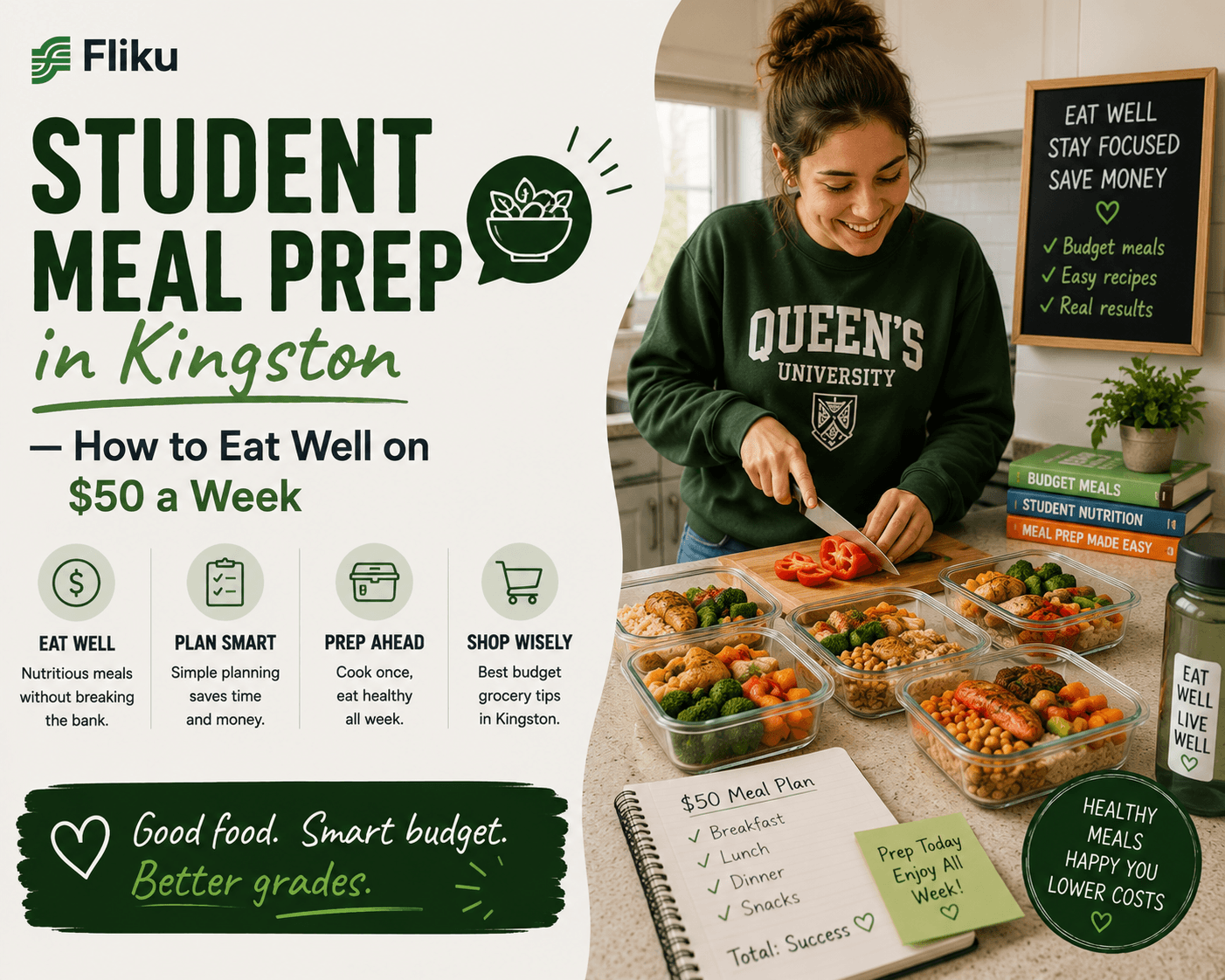
The word "meal prep" makes people picture four hours of Tupperware-filling on Sunday afternoon. That's one way to do it and it's too much for most students. The simpler system is this: cook two or three components on Sunday, not complete meals, and assemble them differently throughout the week.
The three components:
- A grain or starch — A big pot of rice (cost: $0.40), or a batch of roasted potatoes ($1.50), or a box of pasta ($1.20). This takes 20 minutes of active work and provides the base for every lunch and dinner.
- A protein batch — A tray of roasted chicken thighs ($5-7), or a pot of dal ($2), or a dozen hard-boiled eggs ($2.50). This takes 40 minutes of oven time during which you do nothing.
- A vegetable that keeps — Roasted broccoli or cauliflower, sautéed greens, a big pot of soup with whatever vegetables are cheap that week. This takes 20 minutes.
With these three components in the fridge, every meal is an assembly problem, not a cooking problem. Rice + chicken + vegetables = dinner. Same rice + egg + hot sauce = different dinner. Add pasta sauce to the chicken and serve over pasta = different meal again. You're not eating the same thing every day; you're eating different combinations of the same components.
One night cooking: Sunday cooking takes 1.5-2 hours including cleanup. The benefit is zero cooking required Monday through Thursday for lunch and dinner. Friday you might cook something new or order food as a treat. Saturday you're out. The week's food is handled.
A Real $50 Week in Kingston — What It Actually Looks Like
This is a real $50 week for one person, priced at No Frills in Kingston. Not aspirational. Actual food.
| Item | Where | Cost |
|---|---|---|
| Chicken thighs, 1.5kg | No Frills | $7 |
| Eggs, 18-pack | No Frills | $6 |
| Canned tuna, 4 cans | No Frills (on sale) | $5 |
| Canned chickpeas, 2 cans | No Frills | $3 |
| Oats, 1kg | Walmart (stocked last month) | $0 (pre-bought) |
| Rice, 2kg | Walmart (stocked) | $0 (pre-bought) |
| Broccoli, 2 heads | No Frills | $4 |
| Spinach, 1 bag | No Frills | $4 |
| Tomatoes, canned (796ml) | No Frills | $2 |
| Onions, 3kg bag | No Frills | $4 |
| Bananas | No Frills | $2 |
| Greek yogurt, 750g | No Frills | $6 |
| Pasta, 2 boxes | No Frills | $3 |
| Misc (olive oil, soy sauce, etc.) | Walmart (stocked monthly) | $4 (allocated) |
| Total | $50 |
This covers 21 meals plus breakfasts for the week. The Walmart pantry stocking (rice, oats, oil, pasta, canned goods) happens once a month and costs $30-40 amortized to roughly $8-10 per week — accounted for in the allocation above.
The Mistakes That Blow a Kingston Student Food Budget
Buying pre-cut vegetables. Pre-cut broccoli costs $2-3 more than a whole head. You're paying for someone else to spend 90 seconds with a knife. Learn to cut a broccoli head. It takes 2 minutes.
Grocery shopping hungry. You've heard this. It is completely true. A $30 shop becomes a $48 shop when you're hungry and the prepared food section catches you. Eat before you go. Every time.
Buying food you won't cook. The butternut squash that looked interesting in September and is now a monument to good intentions sitting on your counter. Stick to vegetables you already know how to prepare until you've mastered the budget, then experiment.
Eating out as a default rather than a treat. A $14 lunch on Princess Street twice a week is $112 a month on top of your grocery budget. One intentional restaurant meal per week is a reasonable treat. Two or three casual "I didn't feel like cooking" meals per week is where the budget disappears.
Not using your freezer. Bread, meat, cooked rice, soup — all freeze well. If you bought chicken thighs that you won't cook this week, freeze them. Kingston student apartments have freezers and most students use them at 30% capacity.
What Kitchen Equipment Kingston Students Actually Need
You do not need a full kitchen kit. You need five things: a large pot, a frying pan, a sheet pan for the oven, a sharp knife, and a cutting board. That's it. With these five items you can make every meal in this guide.
Buy these used on Fliku for $25-40 total at the start of the year. A graduating student's kitchen kit — good quality, used for one or two years — sells for almost nothing in April because they can't take it home. Your gain.
Frequently Asked Questions
What is a realistic grocery budget for a student in Kingston, Ontario?
A realistic grocery budget for a Kingston student who cooks regularly is $180-220 per month — roughly $45-55 per week. At $50/week, you can eat varied, nutritious food if you shop at discount grocers (No Frills on Princess Street, Food Basics) for weekly perishables and Walmart on Bath Road for pantry staples bought in bulk once a month. Students who spend less than $150/month are usually eating repetitively and running out of motivation to cook. Students spending more than $250/month are paying for convenience (pre-cut vegetables, prepared foods, premium stores) that adds up without adding much to the quality of the food. The $180-220 range hits the sweet spot between food quality and cost discipline.
What are the cheapest grocery stores for students in Kingston?
No Frills on Princess Street is the highest-value grocery store for Queen's students — accessible by bus from campus and priced consistently lower than Loblaws or Metro. Food Basics is similarly priced and worth checking. Walmart Supercentre on Bath Road wins specifically for non-perishable pantry staples: rice, oats, pasta, canned goods, oil, soy sauce, and spices bought in larger quantities cost 15-30% less than grocery store equivalents. The Kingston Public Market at Springer Market Square (Tuesday, Thursday, Saturday) has competitive prices on fresh local produce from May through October — quality is noticeably better than grocery store produce and prices are comparable. Loblaws and Metro have the widest selection and the highest prices; shop there for specific ingredients, not for your weekly basket.
How do Kingston students do meal prep efficiently?
The most practical Kingston student meal prep method is component cooking rather than full meal prep: spend 1.5-2 hours on Sunday cooking a batch of a grain (rice or potatoes), a protein (roasted chicken thighs or dal), and one or two vegetables. These components go in separate containers in the fridge and get combined differently throughout the week — rice bowl on Monday, pasta with the chicken on Tuesday, soup on Wednesday with the leftover vegetables. This approach avoids eating the same meal five days in a row (the most common reason people abandon meal prep) while keeping cooking time to one session per week. The active cooking time is about 45 minutes; the rest is oven time where you're not needed.
What are the cheapest protein sources for students in Kingston?
The cheapest protein sources available at Kingston grocery stores, ranked by cost per gram of protein: eggs ($4-6 per 12, providing 72g protein total), canned tuna or salmon ($1.50-2.50 per can on sale, 20-25g protein each), canned lentils and chickpeas ($1.20-1.80 per can, 15-18g protein each), chicken thighs ($4-6/kg, roughly 25g protein per 100g of meat), and store-brand Greek yogurt ($5-7 per 750g tub, 17g protein per 100g). Eggs and canned fish are the clear leaders for students optimizing protein per dollar. Students who add a can of chickpeas to pasta sauce or rice dishes halve their required meat intake without noticing the difference in satiety.
How much do Queen's University students spend on food per month?
Queen's University students who cook most of their own meals spend $180-250/month on groceries in Kingston. Students who eat out regularly or primarily buy prepared foods spend $350-500+/month on food. Students in meal plans (first-year residence) spend whatever their plan costs — typically $350-450/month for a standard plan. The difference between a student who cooks and one who doesn't is roughly $150-250/month — over an eight-month academic year, that's $1,200-2,000. Learning to cook at the level this guide describes (component prep, discount grocers, pantry stocking) is one of the highest-ROI skills a first-year student can develop in the first month of school.
Fifty dollars a week for groceries in Kingston is not tight — it's planned. The students who eat this way don't feel deprived; they feel competent. Start with No Frills on Princess Street this week, cook a batch of chicken thighs on Sunday, and see how different the month looks. If you're also looking to cut other costs, Fliku has used kitchen equipment, furniture, and everything else Kingston students buy at the start of the year — at prices that leave more room in the food budget.