Quick Answer
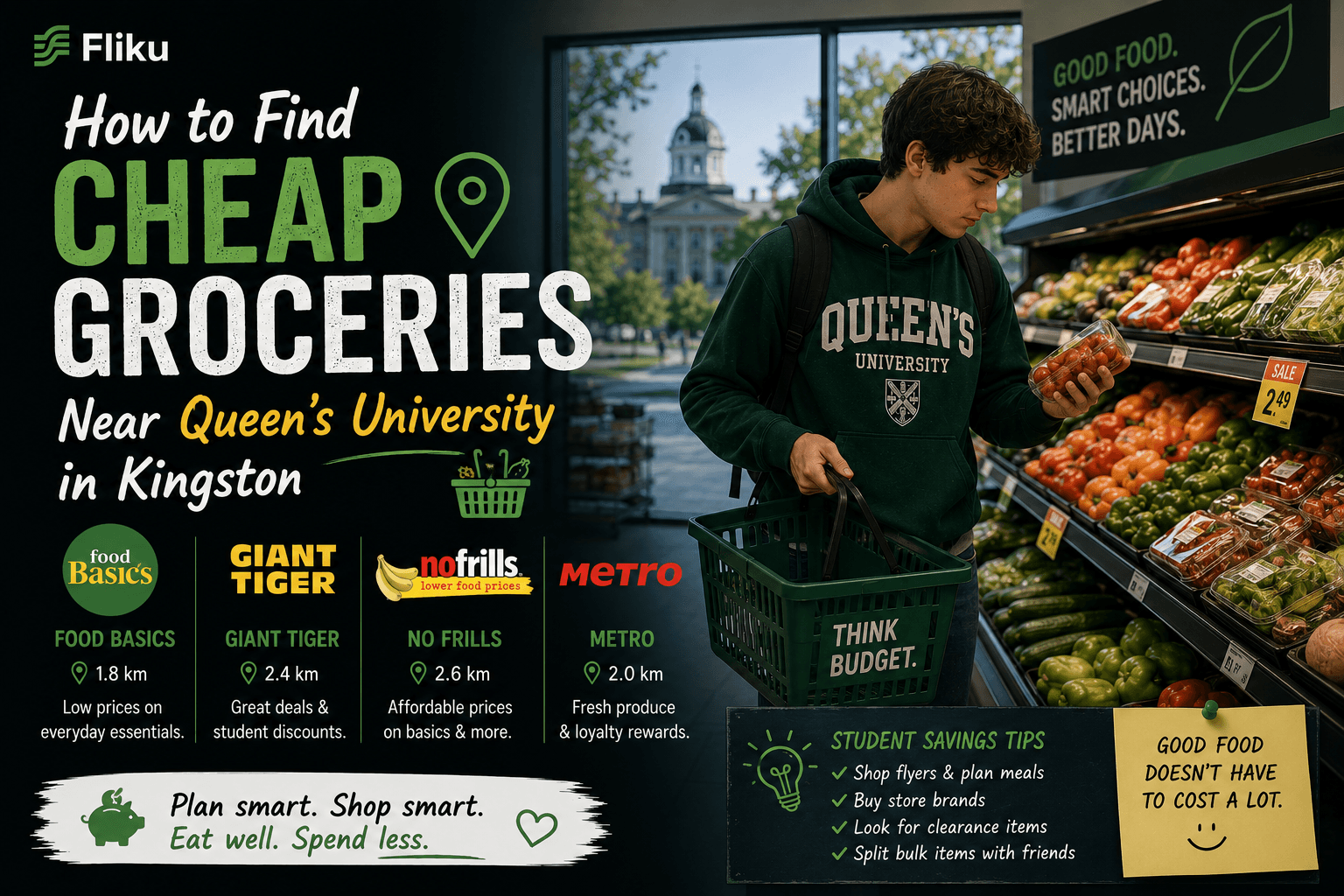
The grocery stores closest to Queen's in Kingston are the most expensive. Here's where Kingston students actually shop to cut their food bill in half — with real prices and real distances.
Cheap Groceries Near Queen's University in Kingston
The Metro on Princess Street is the grocery store closest to the Queen's campus. It is also one of the most expensive grocery stores in Kingston. A student who walks there every week because it's convenient is spending $40-60 more per month than a student who bikes ten minutes to a different store.
Over an eight-month academic year, that's $320-480. That is real money — a month of rent, a flight home, a semester of textbooks — spent on the difference between the convenient grocery store and the slightly less convenient one.
Kingston has good budget grocery options. They are not all next to campus. Here's where they are, how far they are by bike or bus, and what to buy where to eat reasonably well without spending like you have a salary.
The Kingston Grocery Stores — Ranked by Price
Kingston has a range of grocery options that vary significantly in price. Here is an honest ranking:
| Store | Price Level | Distance from Queen's (bike) | Notes |
|---|---|---|---|
| No Frills (Bath Road) | Lowest | 12–15 min | Best overall value for students |
| Walmart (Bath Road) | Low | 15–18 min | Best for dry goods, cleaning supplies |
| FreshCo (Bath Road) | Low–medium | 12–15 min | Good produce quality at low prices |
| Food Basics (Montreal Street) | Low–medium | 20–25 min | Good if you're near Loyalist area |
| Loblaws (Bath Road) | Medium–high | 12–15 min | PC Optimum points, better for brand loyalty |
| Metro (Princess Street) | High | 8–12 min walk | Convenient, expensive — use for emergencies |
| Sobeys (downtown) | High | 10–15 min walk | Similar to Metro in price and convenience |
No Frills on Bath Road — The Student Standard
No Frills on Bath Road is where Kingston students who care about their grocery budget do their main shop. It is not close to campus — 12-15 minutes by bike, 30+ minutes walking — but the price difference versus Metro or Sobeys is significant enough that the trip pays for itself in the first aisle.
Produce at No Frills in Kingston runs 30-50% cheaper than Metro for the same items. A 5kg bag of rice at No Frills is $6.49. The same quantity at Metro is $9.99+. Chicken thighs, pasta, canned goods, dairy — everything runs lower. For a student spending $60/week on groceries at Metro, the equivalent shop at No Frills runs $38-45.
The No Frills Kingston strategy: Go once a week, go by bike (a backpack plus a couple of reusable bags fits a week's groceries), and buy in volume on the items that keep — rice, pasta, oats, canned beans, frozen vegetables. These form the base of a student food budget and buying them at No Frills prices versus Metro prices saves $15-20 per week by itself.
Walmart on Bath Road — Best for Dry Goods
The Walmart Supercenter on Bath Road is the right place for dry goods, cleaning supplies, and frozen foods. Pasta, rice, oats, peanut butter, canned goods, frozen vegetables — Walmart's Great Value house brand prices on these items are consistently the lowest in Kingston.
Walmart is not the right place for fresh produce. The produce quality is inconsistent and the price savings over No Frills or FreshCo on fresh vegetables and fruit are minimal. The split strategy — Walmart for dry goods and frozen, No Frills or FreshCo for produce and fresh protein — covers most of a student food budget at the lowest combined cost.
Kingston Transit connects the Queen's campus area to the Bath Road shopping corridor — the route along Bath Road serves No Frills, FreshCo, Loblaws, and Walmart, and the ride from the University District takes 15-20 minutes. A bus pass is worth considering if you don't have a bike and do your main grocery shop weekly.
Kingston Public Market — The Underrated Option
The Kingston Public Market runs Tuesday, Thursday, and Saturday mornings downtown near City Hall. It is a 15-20 minute walk from the Queen's campus and consistently underused by students who walk past it on the way to Sobeys.
What makes it worth it for budget-conscious students: local produce in season is priced competitively with grocery stores and significantly fresher. Late summer and early fall — the first weeks of the academic year — the market has an abundance of Ontario produce (tomatoes, corn, peppers, apples, squash) at prices that match or beat No Frills. Bread from local bakers is sold at market prices, not retail markups. Eggs from local farms run competitive with grocery store prices and taste noticeably better.
The market is not a full grocery solution — it doesn't have rice, pasta, or cleaning supplies. It is a produce and specialty food supplement to your main grocery shop, particularly valuable in September and October when Ontario's harvest season overlaps with the start of the academic year.
How to Actually Save Money on Groceries in Kingston
The students who spend least on food in Kingston are not the ones who eat poorly. They are the ones who have a system.
Plan meals before you shop, not after. Students who shop without a plan buy ingredients that don't combine into meals, end up ordering takeout because there's nothing ready, and throw out produce that went bad. A 20-minute meal plan on Sunday sets up five days of cheap, real meals and reduces food waste to nearly zero.
Build around cheap proteins that aren't chicken breast. Boneless chicken thighs cost 40% less than breasts and taste better in most cooked dishes. Eggs are the most efficient protein in Kingston's grocery stores — $4-5 for a dozen. Canned tuna is $1.50-2.00 per can. Dried lentils and beans are $2-3 per 900g bag and make a week of lunches. These are the proteins that make a $50/week food budget work.
Buy store brand on everything that doesn't matter. No Frills and Walmart house brand pasta, rice, oats, olive oil, canned tomatoes, and peanut butter are indistinguishable from name brands in their intended use. Spending name-brand prices on these items in Kingston is a significant and unnecessary budget drain.
Cook in batches. A pot of lentil soup, a sheet pan of roasted vegetables, a batch of rice — cooked Sunday evening, these cover lunch and dinner for three or four days without thinking or spending. The per-meal cost of batch-cooked food in Kingston is $1.50-2.50. The per-meal cost of anything ordered or bought ready-made is $10-18.
Use the PC Optimum app at Loblaws. If you shop at Loblaws for its selection or convenience, load the PC Optimum app and check the weekly personalised offers before you go. Points accumulate faster than most students realise and convert to meaningful grocery discounts over a semester.
A Realistic Weekly Food Budget for Kingston Students
| Budget Level | Weekly Spend | Monthly | What It Looks Like |
|---|---|---|---|
| Tight | $40–50 | $160–200 | Oats, eggs, lentils, frozen veg, rice, pasta, chicken thighs. No waste, batch cooking. |
| Moderate | $60–75 | $240–300 | More variety, some fresh fish, better produce, occasional treat items. |
| Comfortable | $85–100 | $340–400 | No restrictions, good quality across the board, occasional specialty items. |
| Metro / convenience store budget | $100–130 | $400–520 | Same food, higher prices due to convenience shopping. |
Frequently Asked Questions
What is the cheapest grocery store near Queen's University in Kingston?
No Frills on Bath Road is the cheapest full-service grocery store accessible to Queen's students in Kingston — 12-15 minutes by bike from the University District. Walmart on Bath Road is comparable or slightly cheaper on dry goods and frozen items. Both are significantly cheaper than the Metro on Princess Street, which is the most convenient store to campus but also one of the most expensive in Kingston. The price difference on a typical student grocery shop is $15-25 per week — $120-200 per month — between No Frills and Metro for equivalent items.
How much should a Queen's University student budget for groceries in Kingston?
A realistic grocery budget for a Kingston student cooking most meals at home is $50-75 per week ($200-300/month), shopping at No Frills or FreshCo on Bath Road. This covers good nutrition with variety — eggs, chicken, fish, lentils, rice, pasta, fresh and frozen vegetables, fruit, and pantry staples. Students who shop at Metro or Sobeys for convenience spend $80-120 per week for equivalent food. The $25-50 weekly difference compounds to $200-400 per semester, which is a meaningful number on a student budget.
How do Queen's students get to the Bath Road grocery stores without a car?
By bike — the ride from the University District to the Bath Road shopping corridor (No Frills, FreshCo, Loblaws, Walmart) takes 12-18 minutes. A backpack plus one or two reusable bags holds a full week's groceries comfortably. Kingston Transit also connects the university area to Bath Road; the ride takes 15-20 minutes and the bus stop is on Bath Road directly in front of the grocery stores. Students without a bike who take the bus weekly to No Frills save significantly more than the bus fare costs compared to shopping at Metro.
Is the Kingston Public Market worth it for students?
Yes, particularly in September and October when Ontario's harvest season coincides with the start of the academic year. The Kingston Public Market (Tuesday, Thursday, Saturday mornings near City Hall) has local produce at prices competitive with grocery stores and significantly fresher quality. It is not a complete grocery solution — no dry goods or cleaning supplies — but as a produce supplement to a main shop at No Frills, it adds variety and quality without adding significant cost. The 15-20 minute walk from the Queen's campus is manageable and the Saturday morning market pairs well with a weekly grocery shop routine.
What are the cheapest meals a Queen's student can make in Kingston?
The lowest-cost real meals for Kingston students, with ingredients from No Frills or FreshCo, are: lentil soup ($1.20-1.50 per serving for a big pot), pasta with canned tomatoes and olive oil ($1.00-1.50 per serving), rice and eggs with frozen vegetables ($1.50-2.00), oatmeal with frozen berries ($0.60-0.80 per bowl), and chicken thigh with roasted vegetables ($2.50-3.50 per serving). These are not compromise meals — lentil soup and roasted chicken are good food. The difference between these and takeout or meal kits is $8-15 per meal, which over a semester is $2,000-4,000.
Food is one of the few major Kingston student expenses you have real control over — and the difference between a thoughtful grocery approach and a convenient one is $200-400 per semester. If you need kitchen gear to actually cook — pots, pans, a rice cooker — buying used in Kingston costs a fraction of new. Browse Fliku for used kitchen appliances, or post a wanted ad for what you need and let Kingston sellers respond.