Quick Answer
Kingston eats bikes. Theft near Queen's is rampant, winters destroy chains, and new bikes are a terrible investment. Here's how to buy used, what to inspect, and how to keep it.
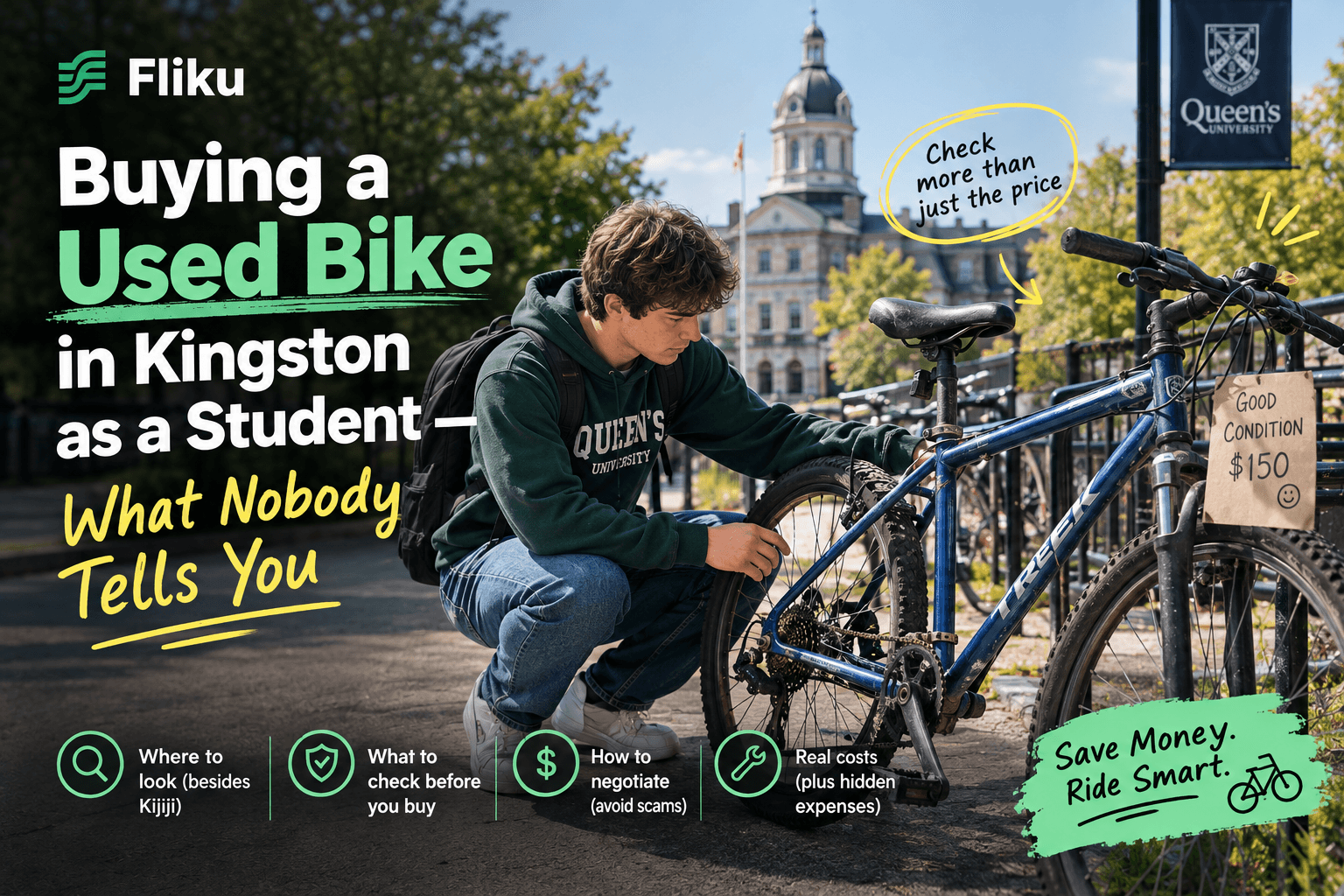
Buying a Used Bike in Kingston as a Student
You need a bike. You've watched how Queen's students move around Kingston — nobody waits for the bus when it's a 12-minute ride to Stauffer Library, the Loblaws on Bath Road, or the bars on Princess Street. A bike is not optional here. It is how Kingston works.
You've also heard the stories. Bike locked outside the JDUC. U-lock still on the rack in the morning. Bike gone. $450 gone. Three weeks into first year.
Kingston has one of the highest bike theft rates per capita of any city in Ontario. The area around Queen's University — University Avenue, Union Street, Earl Street, the campus racks themselves — is particularly bad. Add the fact that Kingston winters rust chains, corrode brake cables, and generally destroy anything left outside for four months, and buying a brand new bike here as a student is genuinely one of the worst financial decisions you can make.
Buy used. Spend $80-150. Lock it properly. Sell it in April. That is the Kingston student bike strategy, and the students who figure it out in week one ride comfortably for four years without ever losing more than $30 on a bike.
What Kind of Bike You Actually Need in Kingston
Kingston is not a mountain biking city and it is not a road cycling city. It is a commuter city. You are cycling from your apartment on Division Street to a lecture hall, from your house on Frontenac Street to the grocery store, from the library back home at 11pm. The terrain is mostly flat with a few mild hills around the Queen's campus on University Avenue.
What you need is a simple, reliable commuter or hybrid bike. Not a racing bike. Not a mountain bike with full suspension. A 7-speed hybrid with decent brakes that starts every morning and gets you where you are going.
Here is what matters on a Kingston student commuter bike:
- Working brakes — non-negotiable. Test them hard before you buy.
- Smooth gear shifting — not perfect, but functional. A bike that gets stuck in one gear is fine for Kingston's flat streets.
- No rust on the chain or frame joints — surface rust on the frame is cosmetic. Rust on the chain or at the joints where tubes meet means structural problems.
- Tires with tread — bald tires on wet Kingston streets in October are genuinely dangerous.
- A seat that adjusts to your height — sounds obvious, seized seat posts are common on older used bikes.
You do not need gears beyond 7-speed. You do not need disc brakes. You do not need anything that adds value and therefore adds to what you lose when it gets stolen.
How Much a Used Bike Costs in Kingston Right Now
The Kingston used bike market is predictable. Prices track the season almost exactly.
| Time of Year | Market Condition | What You'll Pay |
|---|---|---|
| Late August / September | High supply — students selling before leaving Kingston | $60–120 |
| October / November | Supply drops, motivated buyers thinning out | $70–140 |
| December / January | Very low supply, committed winter cyclists only | $50–100 (desperate sellers) |
| March / April | Flood of supply — everyone selling before move-out | $50–100 |
The sweet spot for buying a used bike in Kingston as a student is late August to mid-September. High supply, motivated sellers, and you get the full cycling season ahead of you. A reliable commuter hybrid in this window runs $80-130 on Fliku's bike listings in Kingston. Anything above $150 for a used student bike in Kingston is too much unless it's a name brand in exceptional condition.
What to Inspect Before You Hand Over Any Money
This is the part that saves you from buying a $90 bike that needs $120 in repairs. Test everything with the seller present, in daylight, before you commit.
Brakes first — always: Squeeze both brake levers hard. The wheel should stop immediately with moderate pressure. If the lever pulls all the way to the handlebar before the brakes engage, the cables are stretched and need replacing — factor that cost into your offer or walk away.
Spin both wheels: Lift the bike and spin each wheel. They should rotate smoothly without wobbling side to side. A wheel that wobbles (out of true) will rub the brakes constantly and is annoying to ride. Not dangerous, but a negotiating point.
Shift through every gear: On a 7-speed bike, click through all seven. Each shift should be clean and immediate. Hesitation, skipping, or grinding means the derailleur needs adjustment or the chain is worn. A local Kingston bike shop charges $20-40 for a tune-up — factor this into your price if the shifting is rough.
Check the chain: Lift the chain off the front chainring and look at it. It should be a consistent silver colour with light lubrication. Orange rust means it hasn't been maintained. A rusty chain is a $15 replacement but it tells you the bike hasn't been cared for — check everything else more carefully.
Sit on it and pedal: Ride it around the block. Any creak, click, or wobble you feel while pedalling is worth asking about. A creaking bottom bracket is a $40-60 repair. A wobbling headset is a 5-minute fix with a hex key. Know the difference before you pay.
The City of Kingston's cycling resources also has information on local bike repair programs and cycling infrastructure that's useful when you arrive.
Where to Find Good Used Bikes in Kingston
Fliku's bike listings in Kingston are the best starting point. Every seller is genuinely local — you are not filtering out listings from Ottawa or Toronto the way you do on Kijiji. The volume is highest in late August and April, but bikes appear consistently throughout the year.
A few other Kingston-specific spots worth knowing:
- Limestone City Cycles on Princess Street — occasionally has used bikes for sale alongside their new inventory. Worth calling ahead.
- Facebook Marketplace Kingston — active for bikes, more competition for good listings than Fliku but worth checking simultaneously.
- Queen's University community boards — physical boards in the JDUC and Stauffer Library, and the Queen's Buy & Sell Facebook group, both have bike listings that never make it to broader platforms.
- Your building's Facebook group — an outgoing tenant selling a bike they can't take home will list here first. Zero competition, easy pickup.
Avoid buying from anyone who cannot tell you basic information about the bike — where they bought it, how long they've had it, why they're selling. Stolen bikes get sold in Kingston. A seller who is evasive about the bike's history is a red flag.
How to Keep Your Bike From Getting Stolen Near Queen's
Kingston's bike theft problem is concentrated around the Queen's campus and the streets immediately surrounding it. University Avenue, Union Street, Earl Street, and the campus racks themselves are high-risk. A cable lock will not save your bike here. A chain lock will not save your bike here.
The only lock that works in Kingston's campus area is a U-lock through the frame and rear wheel, attached to a fixed rack. Not just through the wheel — through the frame. A locked wheel with an unlocked frame means someone takes the frame and leaves the locked wheel on the rack. It happens weekly near Queen's.
Practical theft prevention for Kingston students:
- U-lock is mandatory — budget $30-40 for a decent one. Kryptonite Evolution is the standard recommendation.
- Lock through the frame AND rear wheel to a fixed rack every single time, even for five minutes.
- Do not leave your bike locked outside overnight on Princess Street or anywhere near campus bars.
- A beaten-up, ugly bike gets stolen less than a clean, shiny one. This is not a joke — it is a real theft deterrent in Kingston.
- Register your bike's serial number with Kingston Police — recovery rates for registered bikes are significantly higher than unregistered ones.
When and How to Sell Your Bike Before You Leave Kingston
If you bought a used bike in Kingston for $100 and maintained it reasonably, you can sell it for $80-100 in April. You rode it for eight months for $0-20. That is the math that makes buying used in Kingston the obvious choice every time.
List your bike on Fliku by April 14th at the latest — before the end-of-year flood hits. Bikes sell within hours of listing in mid-April because the cycling season is starting and incoming summer students are looking. A bike listed April 14th sells for $95. The same bike listed April 28th sells for $60 because twenty other students are selling simultaneously.
Clean the chain, wipe down the frame, pump the tires, and take photos in good daylight before listing. A clean, well-photographed bike on Fliku in April moves the same day.
Frequently Asked Questions
How much should I spend on a used bike as a Queen's University student in Kingston?
Budget $80-130 for a reliable used commuter or hybrid bike in Kingston. Anything under $60 is likely in poor condition and will need repairs that exceed what you saved. Anything over $150 for a standard used commuter bike is too much in Kingston's student market — you're paying for a name or condition that doesn't justify the theft risk. Buy something functional and forgettable, lock it with a U-lock, and sell it in April for close to what you paid.
Where is the best place to buy a used bike in Kingston, Ontario?
Fliku is the most reliable source for used bikes in Kingston — every listing is genuinely local, and the volume is highest in late August and April when students are buying and selling around lease dates. The Queen's Buy & Sell Facebook group is an excellent secondary source for bikes specifically, as the audience is exactly right. Avoid buying from anyone who cannot explain the bike's basic history — stolen bikes circulate in Kingston's student market every semester.
Is bike theft really that bad near Queen's University in Kingston?
Yes — the area around the Queen's campus consistently has the highest bike theft rates in Kingston. Cable locks and chain locks are not sufficient near campus. The only effective solution is a quality U-lock through the frame and rear wheel attached to a fixed rack. Budget $30-40 for a Kryptonite U-lock when you buy your bike — it is not optional. Register your bike's serial number with Kingston Police, which meaningfully increases recovery rates if it is stolen.
What should I check when buying a used bike in Kingston?
Test the brakes first — squeeze both levers hard and confirm the wheel stops with moderate pressure. Spin both wheels and confirm they run true without side-to-side wobble. Shift through every gear and confirm each shift is clean and immediate. Lift the chain and check for orange rust. Then ride it around the block and note any creaking, clicking, or instability. Anything that fails these checks is either a deal-breaker or a price reduction — get a quote from a Kingston bike shop before you decide how much to offer.
When is the best time to buy a used bike in Kingston as a student?
Late August to mid-September is the best buying window — outgoing students are selling before they leave Kingston, supply is high, and prices are competitive. April is also a strong buying window if you're staying in Kingston for summer, as move-out desperation drives prices down sharply in the final week of the month. Avoid buying in October or November when supply is low and remaining sellers know they have less competition.
A used bike in Kingston is one of the best investments you'll make as a student here — it saves you transit costs, gives you independence across the city, and costs you almost nothing if you buy and sell smart. Browse used bike listings on Fliku right now and find something local. Or post a wanted ad describing what you're looking for — Kingston sellers respond fast.