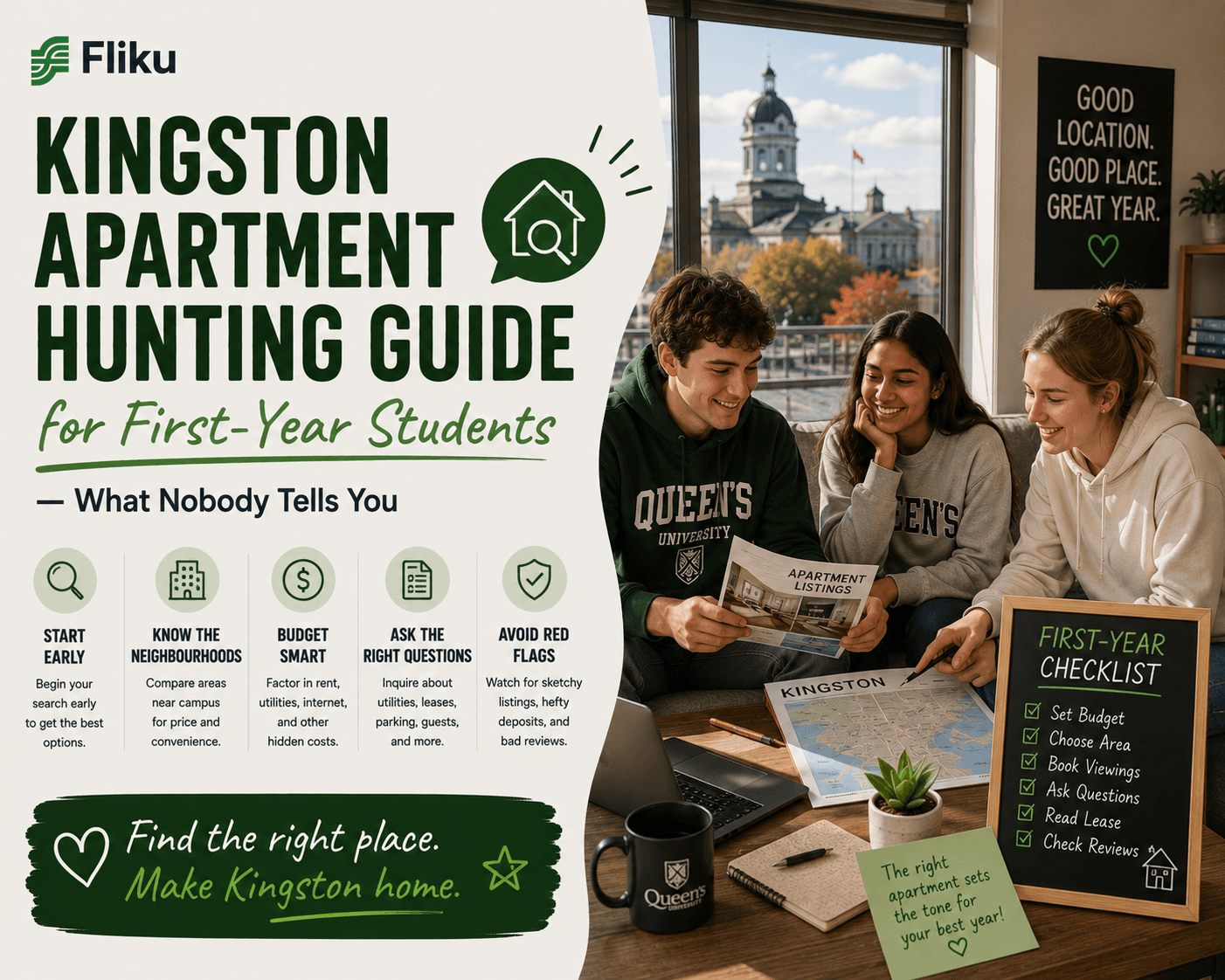
Quick Answer
The Queen's student ghetto explained, what landlords don't tell you, and how to avoid signing a bad lease before you've even arrived in Kingston.
The email comes in mid-November: congratulations, you've been accepted to Queen's. You're relieved, excited, maybe a little overwhelmed. Someone in your Facebook feed posts in the Queen's admitted students group: "Starting housing hunt — anyone want to be roommates?" You think: it's November, I have time. By February you're looking at listings for $900/month per person that you would have laughed at in November, and the good ones are already gone. This is how Kingston student housing works, and knowing it before you need to find housing is the difference between having good options and having whatever's left.
The thing nobody tells you about Kingston apartment hunting: it is one of the most competitive rental markets in Ontario for its city size, and it moves on a timeline that feels illogical until you understand it. First-time Kingston renters consistently underestimate how early the market clears, what questions to ask before signing, and what the Ontario lease actually protects them on. Every section of this guide is designed to fix a mistake that first-year students make every September.
Understanding the Kingston Student Rental Market
Why It Moves So Early
Kingston has approximately 25,000+ Queen's University students plus Loyalist College enrollment, in a city with a general population of around 135,000. The student housing supply in the neighborhoods adjacent to campus is genuinely constrained — Victorian houses converted to student apartments, a limited number of purpose-built student buildings, and a broader rental market that competes for the same properties.
Upper-year students who are already in Kingston and already have local networks snap up the best units before they're widely advertised. The landlords who have good properties frequently rent to previous tenants' friends or take their former tenants' word on the quality of an incoming group. By the time a good apartment appears on Kijiji or Facebook, it's already had 10 private inquiries.
The Timeline You Need to Follow
- November-December: Begin identifying potential roommates and forming groups. This is when incoming students start connecting in admitted students groups. Know who you want to live with before you find the apartment.
- January: Begin actively searching. This is when the visible market opens for September. The best properties listed in January go within days.
- February-March: The primary market window. Most of the good student housing for September is leased in this window. After March, options narrow noticeably.
- April-May: Secondary market — sublets, units with issues that weren't rented earlier, newer listings from landlords who missed the primary window. Not all bad, but less selection and sometimes higher prices.
- June-August: Reduced selection, stress, and whatever remains. This is when students accept apartments they wouldn't have accepted in January.
Kingston's Student Housing Geography
The Student Ghetto
The area bounded roughly by University Avenue, Union Street, Earl Street, and Frontenac Street is where most first and second-year students live. It's a 5-15 minute walk from almost anywhere on Queen's campus, walkable to Princess Street for restaurants and grocery stores, and has the highest density of student-oriented housing in Kingston.
The student ghetto is also where the oldest housing stock is concentrated. Victorian-era houses from the 1880s-1920s, converted to multi-unit student dwellings, vary enormously in quality. Some are well-maintained; some have been in student use for decades with deferred maintenance that has accumulated. The same-aged house two streets over from a renovated property might have single-pane windows, inadequate insulation, aging wiring, and plumbing that dates from another era. Exterior appearance tells you very little — you need to see inside.
West Campus and University District
Housing along West Campus Road and the streets west of the main campus tend to be slightly newer or better maintained than the core student ghetto. Slightly further from the main campus and Princess Street, but connected by campus shuttle. Generally quieter than the student ghetto core.
The Princess Street Corridor (Williamsville)
East along Princess Street from campus — the Williamsville neighborhood — has a mix of purpose-built apartment buildings and older residential housing. Less exclusively student than the ghetto, often better maintained, and for students in programs at the east campus areas, sometimes more conveniently located. Generally a 15-25 minute walk to the main campus depending on exact location.
Downtown Kingston
Apartment buildings in the downtown core offer the quality of purpose-built housing, proximity to the waterfront and Kingston's amenities, and a less party-intensive living environment. The tradeoff: a 20-30 minute walk or transit ride to campus. Worth considering for students who prioritize living environment over campus proximity.
What to Check Before Signing — The Full Inspection Protocol
Legal Status: The Rental Licence
The City of Kingston requires rental property licences for secondary suites and multi-unit residential properties. This is not a technicality — an unlicensed rental unit has no recourse to the usual landlord compliance oversight, and if the city discovers the unlicensed unit, you may be required to vacate. Ask any potential Kingston landlord for their rental licence number before signing. A legitimate landlord provides it without hesitation. Reluctance or inability to provide it is a warning sign that should stop the process.
The Building Envelope: Moisture and Insulation
The most common problems in Kingston student housing are moisture-related (mold, water ingress) and insulation-related (draft, inadequate heating). Both are expensive to remediate and neither is typically visible in listing photos. When viewing:
- Smell carefully when you enter — musty odors indicate moisture problems in walls, floors, or crawlspaces
- Look at ceiling corners and along exterior walls for water staining or discoloration
- Check under sinks and around bathtub surrounds for soft flooring or visible mold
- Feel around window frames for drafts; in older houses, single-pane windows lose significant heat
- Ask what the average monthly hydro bill was for the previous tenants — a unit costing $250/month in winter hydro has a real effective cost higher than its monthly rent suggests
The Heating System
This matters more in Kingston than it might in milder cities. Ask specifically:
- What type of heating does the unit use? (Electric baseboard vs. gas forced-air vs. hot water radiator — electric baseboard is the most expensive to operate)
- Who pays hydro — is it included in rent or billed separately?
- What was the average January hydro bill for this unit?
The Landlord Relationship Assessment
Your landlord's responsiveness to maintenance issues will significantly affect your quality of life for the lease term. Indicators of landlord quality that you can assess before signing:
- Response time to your initial inquiry — a landlord who takes three days to respond to a showing request will take longer to fix a plumbing problem
- Ask about their maintenance response process: "If something breaks, what's your typical response time?"
- Ask if you can speak to current or previous tenants; a landlord who facilitates this is confident in their reputation
- Check the unit's physical condition — evidence of recent maintenance (fresh paint, functioning fixtures, repaired damage) suggests an active landlord
Understanding the Ontario Standard Lease
Ontario law requires all landlords to use the Ontario Standard Lease form for new residential tenancies. This is non-negotiable — landlords who present custom lease documents as replacements rather than supplements are technically non-compliant. They can add Schedule A additional terms (riders) for property-specific rules, but the base form must be the Ontario Standard Lease.
Key provisions you should understand before signing:
- The term: Your lease end date and what happens after. Most Queen's student leases end April 30 or August 31. After the initial term, in Ontario, the tenancy automatically converts to month-to-month — you are not legally required to vacate at lease end unless you choose to.
- Early termination: If you need to leave before the lease ends, your options are subletting (you find a replacement tenant, you remain legally responsible) or assignment (you transfer the lease to a new tenant with landlord consent, they become responsible). Breaking the lease without these options leaves you responsible for rent until the landlord re-rents or the lease ends.
- Last month's rent deposit: Landlords can legally collect last month's rent as a deposit. They cannot collect "first and last plus a damage deposit" — additional deposit beyond last month's rent is not permitted under Ontario law. If a landlord asks for more than rent + last month's, ask why and know you can decline.
- Rent increases during the tenancy: As discussed in the rent negotiation section, increases are capped at the provincial guideline after your first year.
Red Flags That Should Stop the Process
- Won't provide a rental licence number when asked
- Wants to show you only photos, not the actual unit
- Pressures you to sign immediately without time to review
- Asks for cash-only or e-transfer before you've signed anything
- Asks for deposit amounts beyond last month's rent
- Unit is listed at a price significantly below comparable properties — in Kingston's rental market, below-market pricing usually indicates something wrong with the property or the landlord arrangement
- Landlord is evasive about previous tenant experiences
When should first-year Queen's students start looking for apartments in Kingston?
Start forming roommate groups in November-December and begin actively searching in January. The primary market for September move-in clears in January-March. Students who begin in May or June are working with significantly reduced inventory. The most common first-year mistake is assuming September housing is abundant in spring — it isn't, and the good options go early to students who started searching before arriving in Kingston.
What is the student ghetto in Kingston?
The student ghetto is the residential neighborhood adjacent to the Queen's campus, roughly bounded by University Avenue, Union Street, Earl Street, and Frontenac Street. It has the highest concentration of student-oriented housing in Kingston — Victorian-era houses converted to multi-unit rentals, close to campus and Princess Street amenities. Quality varies enormously between individual properties; the location is generally convenient, and in-person inspection of specific units is essential.
How much does it cost to rent an apartment near Queen's University in Kingston?
In the 2025-2026 market: $750-1,000 per person per month in a shared house in the student ghetto, with higher prices for renovated units and lower prices for older properties with more roommates. One-bedroom apartments run $1,400-1,800/month total. Utilities not included are common in older houses and add $70-150/person/month in winter. Understand the total cost including utilities before comparing prices between units.